

Bhaktapur and Patan: The Valley's Other Two Cities
Kathmandu gets the headline, but Bhaktapur and Patan hold more intact Newar architecture. Here is what to see, what it costs and how long to give each.
NepGem team · Local guides and trip planners
· 13 min read

Kathmandu's Durbar Square draws the crowds, but the Kathmandu Valley actually holds three royal cities, and the other two have kept more of what made them worth visiting in the first place. Bhaktapur and Patan were independent Malla kingdoms until the 18th-century unification of Nepal folded them into one state, and each still carries its own Durbar Square, its own temple architecture, and its own version of Newar culture, largely undiluted by the traffic and vehicle access that reshaped central Kathmandu. This guide sits alongside the Kathmandu travel guide as the answer to a specific question: given limited days in the valley, what do Bhaktapur and Patan actually offer, and is either worth the entry fee and the half-day it costs. The short answer for both is yes, and the longer answer is that they solve different problems: Bhaktapur rewards slowing down and staying the night, while Patan rewards pairing an old-city walk with the valley's best museum and its most contemporary evening-out neighbourhood.
Why these two beat central Kathmandu
Bhaktapur and Patan preserve more intact Newar architecture than Kathmandu's Durbar Square largely because of how each city recovered from Nepal's two major earthquakes. Kathmandu's core sits on a major traffic corridor and absorbed decades of ad hoc modern construction around its monuments long before the 2015 Gorkha earthquake added further damage; Bhaktapur, by contrast, restricts motor vehicles from its old core entirely, and its post-1934-earthquake and post-2015 reconstruction work leaned on traditional brick-and-timber techniques rather than concrete infill, so its skyline still reads as coherent medieval Newar city rather than monument-plus-modern-town. Patan's old city, similarly, keeps its brick courtyards and bahal (monastery courtyard) layout largely intact, with the Patan Museum widely regarded as the best-curated museum in Nepal sitting inside a former royal palace wing rather than a purpose-built modern building. Neither city is a museum piece in the frozen sense: both are lived-in, with families cooking, weaving and drying grain in the same courtyards tourists photograph, which is part of what makes an overnight stay in Bhaktapur specifically worthwhile rather than merely convenient. Kathmandu's Durbar Square is still worth seeing first, since it anchors the valley's history and sits closest to Thamel, but visitors who stop there and assume they have "done" Kathmandu Valley heritage are skipping the two squares locals themselves tend to rate higher for atmosphere. Both cities also charge their entry fee at clearly marked gates rather than informally, which means the fee itself functions as a rough filter on visitor volume: Bhaktapur in particular sees noticeably thinner crowds than Kathmandu's free-to-enter core, and that quiet is part of what you are paying for.
Bhaktapur
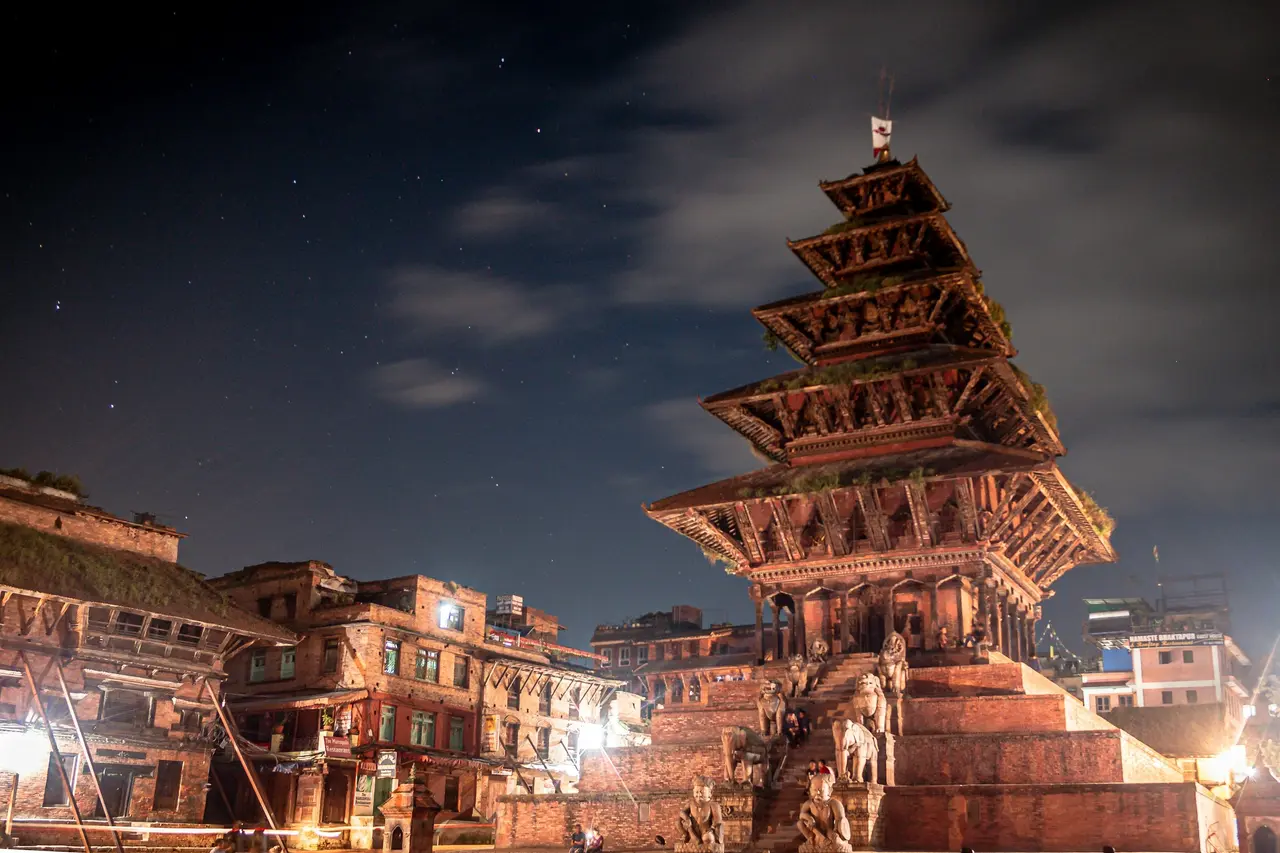
Bhaktapur is a walkable, largely pedestrianised old city roughly 13 km east of central Kathmandu, and its foreign-visitor entry fee funds the city's own heritage conservation, which is a meaningful part of why its restoration work has stayed more faithful to traditional materials than elsewhere in the valley. Durbar Square itself is smaller than Kathmandu's but denser with intact structures: the 55-Window Palace, the Golden Gate, and Vatsala Durga temple sit within a few hundred metres of each other, largely rebuilt after the 1934 earthquake using period-appropriate carved wood and brick. A five-minute walk east brings you to Taumadhi Square and the Nyatapola temple, a five-tiered pagoda roughly 30 metres tall, built in 1702 and among the tallest temples in Nepal; it survived the 2015 earthquake with only minor damage, a fact locals will point to as evidence of the original builders' skill.
Pottery Square, a short walk south of Durbar Square, is a working square rather than a display: potters throw and dry clay pots in the open air using techniques largely unchanged for generations, and it is one of the few places in the valley where a craft process is genuinely visible rather than staged. Dattatreya Square, on the city's eastern edge, holds the 15th-century Dattatreya Temple and the carved Pujari Math with its celebrated peacock window, and sees a fraction of the foot traffic of Durbar Square itself, making it a good place to slow down after the day's busier stops. Between the main squares, Bhaktapur's back lanes reward unplanned wandering more than either Kathmandu or Patan's: narrow brick alleys open unexpectedly onto small neighbourhood squares, each with its own minor shrine, communal water tap (hiti) and resident dogs, and there is rarely a wrong turn since the old city's compact size means you are never more than ten minutes from a landmark you recognise.
As of the current season, the foreign-visitor entry fee for Bhaktapur is levied at the city gates and priced meaningfully higher than Kathmandu or Patan's Durbar Square fees, reflecting the city's self-funded conservation model, under which ticket revenue is reinvested directly into the old city's restoration rather than passed to national tourism authorities; treat any specific figure as needing a fresh check at the gate, since Bhaktapur has adjusted its fee more than once in recent years, and it typically runs well above the standard Kathmandu Durbar Square rate. Is it worth it: yes, and by a clear margin, because the fee buys access to a city core that has stayed more architecturally honest than either of its rivals, and one that features prominently on any serious tour of Nepal's UNESCO World Heritage Sites. Ticket booths issue a same-day, multiple-entry pass, so if you want to step out of the old core for lunch and return in the evening for the empty-square light, that re-entry is normally built into the fee rather than charged again.
Patan
Patan, also called Lalitpur, sits just across the Bagmati River from Kathmandu, close enough that it is often mistakenly treated as a Kathmandu suburb rather than its own former royal city. Its Durbar Square is more compact than Bhaktapur's but arguably denser with fine stone and wood carving: the Krishna Mandir, built entirely in stone in a style unusual for the valley's mostly brick-and-timber temples, sits directly opposite the old royal palace complex, part of which now houses the Patan Museum. The Patan Museum is worth calling out specifically: it occupies restored palace courtyards and presents Nepal's bronze and repoussé religious art with the kind of curatorial care, lighting and English-language context that is genuinely rare in South Asian museums, and even visitors who normally skip museums tend to find it worth the hour or two.
Beyond Durbar Square, the Golden Temple (Hiranya Varna Mahavihar), a working Buddhist monastery a short walk north, holds an ornately gilded courtyard shrine still used daily by resident monks. Mahabouddha, tucked down a narrow lane south of Durbar Square, is a terracotta temple built entirely from thousands of carved clay tiles depicting the Buddha, rebuilt after earthquake damage using salvaged original tiles wherever possible. Patan is also the valley's most useful base for a modern evening out: the Jhamsikhel neighbourhood just south of the old city has become Kathmandu's most concentrated café, bar and international-restaurant strip, a genuinely different register from the temple squares a fifteen-minute walk away, and a useful pairing for a full day that starts in heritage and ends in something more contemporary.
Patan's Durbar Square entry fee is generally the lowest of the valley's three, and the ticket typically includes access to the Patan Museum itself, so the two are worth budgeting as a single admission rather than two separate costs. The old city's bahal system, dozens of Buddhist monastic courtyards tucked behind unmarked doorways off the main streets, rewards visitors willing to duck through an open gate rather than stick to the obvious tourist route; many are still active as Buddhist community spaces, with prayer wheels, small stupas and resident families sharing the same courtyard. Patan is also historically the valley's centre of metalwork, and small workshops producing repoussé statues and ritual objects using techniques centuries old still operate within a few streets of Durbar Square, some open to watching the process rather than only buying the finished piece.
Getting there
Both cities are straightforward day trips from central Kathmandu, and neither strictly requires a private vehicle, though the practical experience differs. Patan is the closer and simpler of the two: a taxi from Thamel typically takes 20–30 minutes depending on Kathmandu's traffic, a ride-hailing app like Pathao runs cheaper than a street-hailed taxi and lets you see the fare upfront, and local buses running along the Ring Road corridor also connect the two, though with more waiting and less predictability. Bhaktapur, at roughly 13 km, takes 45 minutes to over an hour by road depending on traffic and time of day; a direct taxi is the most time-efficient option, a Pathao or similar app ride is the cheaper equivalent, and local buses run from Bagh Bazaar and other Kathmandu stops but add real time to the trip. A useful sequencing option for a single long day is Kathmandu to Patan in the morning, Patan to Bhaktapur by early afternoon (roughly 20–30 minutes between the two), and either a return to Kathmandu or an overnight in Bhaktapur to close the day. Traffic across the whole valley is heaviest on the Ring Road corridor between roughly 8–10 am and 5–7 pm, so a mid-morning departure after the commute has cleared, or a return after the evening rush has eased, both shave meaningful time off any of these routes. Neither city is realistically reachable on foot from central Kathmandu, and cycling, while possible for confident riders, means sharing narrow, unmarked-lane roads with fast-moving buses and motorbikes for most of the route, which makes it a poor choice for a first visit regardless of fitness.
| Route | Typical time | Best option |
|---|---|---|
| Kathmandu (Thamel) to Patan | 20–30 min | Taxi or Pathao |
| Kathmandu (Thamel) to Bhaktapur | 45–70 min | Taxi or Pathao |
| Patan to Bhaktapur direct | 20–30 min | Taxi or Pathao |
Where to eat in each
Patan's food scene is dominated by Jhamsikhel, where cafés, craft coffee roasters and restaurants spanning Nepali, Japanese, Italian and Middle Eastern menus sit within a few walkable blocks, priced closer to Kathmandu's mid-range tourist restaurants than to a local eatery. Inside Patan's old city itself, smaller Newar restaurants serve traditional dishes like yomari (steamed rice-flour dumplings, typically festive food) and bara (lentil pancake) at prices well below Jhamsikhel's café strip. Bhaktapur's signature food experience is juju dhau, literally "king curd," a thick, caramel-set yoghurt traditionally made and served in unglazed clay pots that impart a distinct earthy flavour; small shops around Durbar Square and Pottery Square sell it fresh, and it is worth seeking out specifically rather than treating as a generic yoghurt stop. Both cities also serve full Newar feast platters, khaja sets combining beaten rice, spiced meat, pickles and lentils, in traditional courtyard restaurants, generally at a modest premium over standard Nepali food given the number of separate dishes involved. Treat any specific restaurant name or menu price as needing its own on-the-day check rather than a fixed figure carried from an old guide. Timing matters more than most visitors expect: Jhamsikhel's café strip runs from mid-morning through late evening and is genuinely at its best after dark, while Bhaktapur's old-city eateries thin out noticeably once Durbar Square's day-trip crowd leaves in the late afternoon, so a Bhaktapur dinner is better planned in advance or taken at an overnight guesthouse than discovered by wandering after 6 pm.
Staying overnight in Bhaktapur
The single most underrated move in the whole valley is spending one night inside Bhaktapur rather than treating it as a same-day round trip from Kathmandu. Nearly every visitor arrives after the morning tour buses and leaves before dusk, which means the two or three hours after the day-trip crowd departs are when Bhaktapur's squares empty out, the light goes gold on the brick and carved wood, and the city's actual residents reclaim the courtyards for evening routines that tourists rarely see: kids playing in Pottery Square, families drying grain, temple bells at dusk with no crowd around them. A small number of guesthouses inside or immediately adjacent to the old core offer heritage-building rooms at rates generally below equivalent Kathmandu options, reflecting lower land costs and a smaller hospitality market rather than lower quality. Staying overnight also means a genuinely quiet early morning walk through Durbar Square before the entry gates see their first coach group, which is worth more than the extra logistics of one additional overnight bag. It also solves a real scheduling problem for anyone flying to Lukla or another mountain airstrip in the following days: Bhaktapur sits closer to Tribhuvan International Airport than most of Thamel, and a Bhaktapur overnight the night before an early domestic flight can shave real time off a pre-dawn transfer compared with crossing central Kathmandu's morning traffic from Thamel. Guesthouses inside the old core range from simple family-run rooms in restored traditional houses to a small number of more polished heritage properties, and either sits well below what an equivalent heritage-building stay would cost inside Kathmandu's more built-up core, though exact rates deserve their own check rather than a number repeated from an old guide.
FAQ
Is Bhaktapur worth the entry fee? Yes. It is the most intact medieval Newar city in the valley, its restoration has stayed closer to traditional materials than Kathmandu's core, and staying overnight lets you see the square empty of day-trip crowds at dawn and dusk, which is where the fee earns itself back most clearly.
How far is Bhaktapur from Kathmandu? Bhaktapur sits roughly 13 km east of central Kathmandu, a journey of 45 minutes to over an hour by taxi or Pathao depending on traffic, or somewhat longer by local bus. It is a straightforward half-day or full-day trip, and an easy add-on to a Patan visit earlier the same day.
Which is better, Bhaktapur or Patan? They are not really competing for the same slot: Bhaktapur wins on intact medieval atmosphere and is best with an overnight stay, while Patan wins on the single best museum in Nepal and pairs naturally with an evening in Jhamsikhel. Most visitors with two days should do both rather than choose.
How long do you need in Bhaktapur? Budget at least half a day, three to four hours, to cover Durbar Square, Taumadhi Square and Pottery Square without rushing. A full day, or an overnight stay, adds Dattatreya Square and the empty-square experience at dawn or dusk that a rushed day trip misses entirely.
Where the real risk in Thamel-to-valley day trips comes from
Bhaktapur and Patan are safe, well-signposted, easy places to explore on foot with a paper map or a phone, which is exactly why the risk in a Kathmandu Valley trip sits elsewhere: in whichever agency or driver you trust for the harder logistics later, once you leave the valley floor for an actual trek. A Durbar Square ticket booth cannot check a trekking guide's licence for you, and neither can a hotel noticeboard flyer. NepGem's guides carry a visible licence number, a recorded altitude history and real trekker reviews, all checkable before you pay a deposit, whether you are booking a curated group departure, joining one that already has people on it, or hiring that specific guide directly for your own dates. Spend your valley days on Bhaktapur's brick lanes and Patan's carved courtyards; spend the five minutes it takes to verify a guide's credentials before you commit to the mountains.


