

Nepal's New Years: Losar, Bisket and Nepal Sambat
Nepal runs on several calendars at once. Bikram Sambat, Nepal Sambat and Tibetan Losar each bring their own new year — here is which is which, and where to see them.
NepGem team · Local guides and trip planners
· 12 min read

Nepal marks the turn of the year several times over, because several calendars operate in the country simultaneously and none of them has displaced the others. The Bikram Sambat calendar is Nepal's official state calendar and sets the mid-April new year most visitors hear about; the Newar community keeps its own lunar calendar, Nepal Sambat, with a new year in autumn; and Tibetan-Buddhist communities — Sherpa, Tamang, Gurung and others of Tibetan cultural origin — mark Losar, a new year on the Tibetan lunar calendar, at a different point again. Layered alongside all of this is Holi, a spring colour festival that is not a new year at all but falls close enough to Bikram Sambat's turn that visitors often conflate the two. This article works through each one, plus Bhaktapur's Bisket Jatra, the most spectacular single new year celebration in the country. For where these sit in the wider calendar, see the nepal festival calendar overview.
 [PHOTO]
Why one country has several new years
Four calendar systems run in active use in Nepal, and Nepalis move between them without much friction because each one is tied to a specific community, purpose or ritual context rather than competing for the same role. The Gregorian calendar is used for international business, banking coordination and increasingly for everyday planning, especially in Kathmandu. The Bikram Sambat (BS) calendar is Nepal's official calendar for government, legal and administrative purposes — Nepali dates on official documents, the fiscal year, and public holidays are all set by it — and it runs roughly 56 to 57 years ahead of the Gregorian calendar, with its new year falling in mid-April rather than January.
Nepal Sambat is a lunar calendar specific to the Newar community of the Kathmandu Valley, traditionally dated from 879 CE and used for Newar cultural and ritual timing rather than official state business; its new year falls on Tihar's fourth day, described below. The Tibetan calendar, a distinct lunisolar system, governs Losar and other Buddhist ritual dates observed by Sherpa, Tamang, Gurung and other communities of Tibetan cultural heritage, concentrated in the high mountains and parts of the Kathmandu Valley. A traveller planning around any Nepali festival date should therefore always ask which calendar is being used before assuming a fixed Gregorian date, and use a current-year calendar conversion rather than working from a previous year's dates, since none of these systems tracks the Gregorian year on a simple fixed offset.
None of the four systems has ever fully displaced the others, which is itself worth understanding rather than treating as a curiosity. Bikram Sambat became the state calendar in the twentieth century as part of a broader project of national administrative standardisation, but it was layered onto a country where Newar communities had already kept Nepal Sambat for over a thousand years and Buddhist communities of Tibetan heritage had followed their own lunar reckoning for centuries before that. Each calendar survived because it serves a function the others do not: Bikram Sambat coordinates the state, Nepal Sambat carries specifically Newar cultural continuity, and the Tibetan calendar governs a religious ritual cycle that has never been tied to Nepali statehood at all. A visitor who understands this layering will not be surprised to see a Newar shopkeeper in Bhaktapur reference three different years in casual conversation without contradiction.
Losar
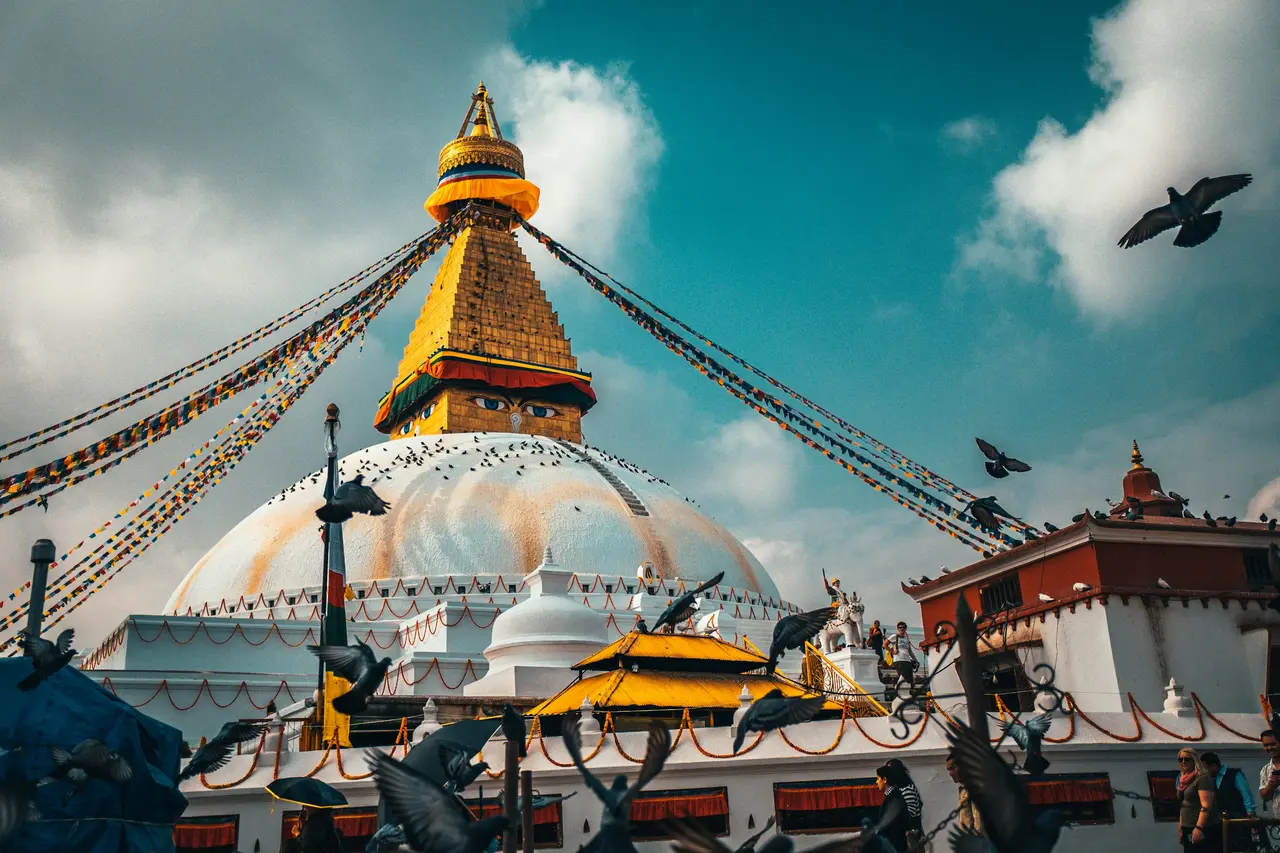
Losar means "new year" in Tibetan and is celebrated by Nepal's Tibetan-Buddhist communities, but it is not a single shared date — three distinct Losars are observed by different communities at different points in the year. Gyalpo Losar, the main Tibetan new year tied to the Tibetan lunisolar calendar, usually falls in February or March and is the Losar celebrated by Sherpa communities in the Everest region (Solukhumbu) and by Tibetan communities and monasteries around Kathmandu, particularly Boudhanath, where days of prayer flag renewal, monastery ceremonies and family gatherings mark the occasion. Sonam Losar, observed roughly a month before Gyalpo Losar by some Tamang and other communities, follows a related but separately reckoned calendar. Tamu Losar, the new year of the Gurung community, falls in mid-to-late December and follows the Gurung people's own twelve-year animal-cycle calendar, distinct from the Tibetan lunar calendar that governs the other two.
The practical distinction matters for a traveller: seeing Gyalpo Losar means being in Solukhumbu or at Boudhanath and Swayambhunath in Kathmandu in February or March, where monastery courtyards fill with monks performing ritual dances and lay communities gather for family meals and new clothes; Tamu Losar celebrations concentrate instead in Gurung communities of the Annapurna and Lamjung foothills and in Kathmandu's Gurung diaspora neighbourhoods, in December rather than late winter. Conflating the three, or assuming all Tibetan-heritage Nepalis celebrate on the same day, is a common and avoidable mistake in festival coverage.
Preparations for Gyalpo Losar typically begin days beforehand with a thorough house cleaning, the baking of a deep-fried bread called khapse, and the brewing or buying of chhaang, a fermented barley or millet drink served throughout the new year visits that follow. On the new year morning itself, families visit the local monastery before calling on relatives in strict order of seniority, not unlike the tika visits of Dashain, and it is common for a household to display a decorated wooden box of auspicious foods — dried fruit, roasted barley flour (tsampa), and sweets — offered to every visitor across the following days. Trekkers passing through Namche Bazaar or Khumjung during Gyalpo Losar will find lodges and monasteries noticeably livelier than during an ordinary trekking-season week, with dance performances at Tengboche Monastery a particular highlight when the timing lines up.
Bisket Jatra in Bhaktapur
Bisket Jatra is Bhaktapur's own new year festival, timed to coincide with the Bikram Sambat new year in mid-April, and it plays out across Bhaktapur Durbar Square, one of the nepal unesco world heritage sites in the Kathmandu Valley — making it arguably the most dramatic single festival day held inside any of Nepal's protected heritage sites — a nine-day event built around a genuinely dangerous chariot tug-of-war rather than a quiet ceremonial turn of the calendar. Two enormous wooden chariots, one carrying the deity Bhairav and a second carrying Bhadrakali, are hauled through Bhaktapur's streets by crowds divided between the town's upper and lower quarters, who pull the chariots in opposite directions in a real contest over which side controls their route — a rivalry with genuine local stakes rather than staged theatre, and one that has occasionally resulted in serious injury or death when a chariot has tipped or a rope has snapped, which is worth knowing before standing close to the pulling ropes.
Alongside the chariot tug-of-war, a second ritual marks the new year at Bhaktapur's Yosinkhel ground: a tall wooden pole, the lingo, decorated with banners representing two serpent deities associated with a local legend of a princess and the demons who killed her previous husbands each wedding night, is raised on the eve of the new year and ceremonially felled the following day, an act understood to mark the old year's end. In the nearby town of Bode, close to Thimi, a further and more extreme ritual takes place on the same general festival calendar: a volunteer has his tongue pierced with a foot-long iron skewer and is carried through the town in procession, a practice tied to a specific local legend and undertaken as a vow of devotion — a striking and genuinely under-covered ritual that draws a much smaller crowd of onlookers than the main Bhaktapur chariot event, since it happens in a smaller neighbouring town rather than the Durbar Square itself.
Holi
Holi, known in Nepal as Fagu Purnima, is the spring festival of colour, falling on the full moon of the Nepali month of Falgun — usually February or March — and it is celebrated differently across Nepal's two main geographic zones rather than on a single uniform day. In the hill regions, including Kathmandu and Pokhara, Holi is generally celebrated a day earlier than in the Terai, the southern plains bordering India, where celebrations often extend to two days and are more closely aligned with the timing of Holi across the border in India. In both regions the core practice is the same: crowds, often strangers as much as friends, throw coloured powder (abir) and water at each other in public squares and streets, and the days beforehand see stalls selling packets of colour and water balloons across every town of any size.
The honest section on Holi concerns safety and consent, particularly for women travellers, since Kathmandu's most tourist-heavy squares — Basantapur and parts of Thamel in particular — have a documented pattern of opportunistic groping and unwanted physical contact under cover of the festival's crowded, boisterous atmosphere, reported by both Nepali women and foreign visitors in multiple years. The practical advice given by Nepali women's safety campaigns each Holi season is straightforward and worth repeating plainly: travel in a group rather than alone, avoid the densest, most alcohol-heavy crowds in the main tourist squares if the atmosphere feels unsafe, wear clothes you are comfortable being covered in colour and hard to grab onto, and be loudly and immediately firm about unwanted contact rather than assuming it will stop on its own. None of this should discourage participation — Holi in a smaller, more community-oriented setting, or with a local guide or host family, is widely enjoyed without incident — but arriving with the same caution recommended for any large, crowded public festival is sensible rather than alarmist.
Mha Puja and Nepal Sambat
Nepal Sambat, the Newar lunar new year, is marked on the fourth day of Tihar (covered in full in the tihar festival article) with Mha Puja, a ritual of self-worship in which each family member is seated on a mandala of coloured powders and ritually honoured in turn, treating the body and life force of the person themselves as sacred rather than directing worship solely at an external deity. Public Nepal Sambat celebrations extend beyond the household ritual into street processions in Kathmandu, Patan and particularly Bhaktapur, where Newar cultural organisations mark the calendar's continuity with music and costume that is distinct from both the Bikram Sambat new year in April and Losar in winter.
Because Nepal Sambat runs on its own count from a 879 CE starting point, its year number does not match either the Gregorian or Bikram Sambat year, and Newar cultural materials, calendars and signage in the Kathmandu Valley will sometimes display all three year numbers side by side — a genuinely useful, if occasionally confusing, marker of just how many calendar systems Nepal's capital region keeps in simultaneous use.
Calendar conversion for travellers
The practical rule for converting between Gregorian and Bikram Sambat dates is to subtract 56 or 57 years from the BS year to reach the Gregorian equivalent, with the exact offset depending on which month is in question, since the BS new year falls in mid-April rather than January and the two calendars' years do not stay aligned across a full Gregorian year. A specific BS date such as a public holiday or festival day should always be checked against a current online BS–AD converter or the current year's official Nepali patro rather than calculated by hand from the approximate offset, since Nepal Sambat and Tibetan Losar dates layer further lunar and lunisolar rules on top of this that a simple year-offset calculation cannot capture. Government offices, banks and most schools in Nepal follow the Bikram Sambat calendar for their public holiday schedule, so it is this calendar, more than any of the others, that determines whether a given day of your trip will find offices open.
For trip planning purposes, the practical takeaway is simpler than the underlying calendar mechanics: treat every festival date in this article, and in the wider nepal festival calendar, as a lunar or lunisolar rule rather than a fixed Gregorian date, and confirm the specific date for your travel year before booking flights, permits or guides around it.
FAQ
When is Nepali New Year? Nepal's official new year, on the Bikram Sambat calendar, falls in mid-April. But Nepal also marks Nepal Sambat, the Newar new year, in autumn during Tihar, and Tibetan-Buddhist communities celebrate Losar in winter or early spring — so "Nepali New Year" can mean three different dates depending on which community and calendar you mean.
What year is it in Nepal? The Bikram Sambat calendar, Nepal's official calendar, runs roughly 56 to 57 years ahead of the Gregorian calendar, so a Gregorian year in the 2020s corresponds to a Bikram Sambat year in the 2080s. The exact offset shifts slightly depending on the month, since the BS new year falls in mid-April rather than January.
What is Bisket Jatra? Bisket Jatra is Bhaktapur's dramatic new year festival, held around the mid-April Bikram Sambat new year, centred on a genuinely dangerous chariot tug-of-war between the town's upper and lower quarters and the raising and felling of a tall ceremonial pole, the lingo, at the Yosinkhel ground.
Is Holi safe for tourists? Generally yes with reasonable caution, though Kathmandu's most crowded tourist squares have a documented pattern of unwanted physical contact toward women during Holi. Travelling in a group, avoiding the densest crowds if the atmosphere feels unsafe, and being firm about unwanted contact are the standard, sensible precautions recommended each year.
Time a trek around the celebration you actually want to see
Bisket Jatra, Losar and Holi each fall on different calendars and different weeks depending on the year, which makes them easy to miss by a few days if you plan a trip around a remembered date rather than the current year's calendar. NepGem's departure pages are dated against the actual Gregorian calendar for the year you are booking, so joining a departure that already has people on it around, say, Sherpa Losar in Solukhumbu or the mid-April new year in the Kathmandu Valley means arriving solo without having to build the itinerary or verify the dates yourself. Guides based in the region a festival belongs to — a Sherpa guide during Losar, a Newar guide during Bisket Jatra — can also point out what is happening at a given moment far better than a schedule alone.


