

SIM Cards, Wifi and Staying Online in Nepal
NTC beats Ncell on the trails, teahouse wifi runs on prepaid cards that fail above 4,000 m, and eSIMs cost more for less hassle.
NepGem team · Local guides and trip planners
· 11 min read

You will want to be reachable on a Himalayan trail, and the honest answer is that no single network gets you there cleanly. This guide compares Nepal Telecom (NTC) and Ncell village by village, explains how the prepaid Everest Link wifi system actually works above Namche, and tells you where an eSIM is worth the premium and where it just fails quietly. Sort your SIM after immigration and after the Nepal visa on arrival process, while you are still in the arrivals hall with your passport in hand — both major carriers have counters right there.
The short answer
For trekking above 3,000 m, buy an NTC (Nepal Telecom, sold as Namaste) SIM — its tower network reaches furthest up the high valleys, including a chain of solar-powered masts along the Everest and Annapurna routes. If you are staying mostly in Kathmandu and Pokhara and want faster data for streaming and video calls, Ncell edges ahead in the cities and mid-hills. An eSIM from a reseller such as Airalo or Holafly is the least-hassle option for short trips and covers Kathmandu and Pokhara well, but it rides on the same physical NTC and Ncell towers once you leave town, so it inherits the same mountain gaps — you are paying more for convenience, not for better coverage.
Most independent trekkers end up carrying an NTC SIM as their primary line and treating anything beyond that — an eSIM as backup, a second Ncell line for the city leg — as insurance rather than necessity. If you plan to rely on your phone for safety communication in a restricted or high-altitude area, read this alongside the Nepal trekking packing list and the notes on drones and satellite devices in Nepal, since a satellite messenger, not a SIM card, is the honest answer for the sections where both networks disappear entirely.
Buying a SIM: documents and where
You need your passport, one passport-sized photo (though most counters will photograph you on the spot with a phone camera), and your Nepal visa sticker or entry stamp. Both NTC and Ncell have counters inside the arrivals hall at Tribhuvan International Airport, just past baggage claim and before you exit — this is genuinely the easiest place to buy, even though the queue can run 15–20 minutes at peak arrival times. If you would rather not queue on arrival, Thamel and Pokhara's Lakeside are dense with authorised SIM shops, and most trekking-gear stores that cater to foreigners sell tourist SIMs alongside a data top-up — sorting a SIM is one of the practical tasks worth ticking off in your first 24 hours in Kathmandu, before you head out to shop for gear or start sightseeing.
Registration is mandatory and biometric — your passport photo page is scanned and your fingerprint is often taken, a rule brought in to curb SIM fraud. This takes five to ten minutes per SIM, so budget for it rather than treating it as an afterthought between other airport tasks. A tourist SIM itself costs a small nominal fee, typically under USD 2 equivalent in NPR, before you add any data. Activation is usually immediate, though it can occasionally take up to an hour to register on the network, so test it — call or message someone — before you leave the shop.
Bring a phone that is unlocked to any carrier; a phone still locked to a home-country network will reject the Nepali SIM outright, and there is no way to fix this in Nepal. If you are unsure, unlock it before you fly, not after you land.
Data plans and real prices
Both carriers sell tourist data-and-voice bundles rather than a plain SIM with pay-as-you-go top-ups, and both revise these packages often enough that any number printed here should be treated as a band, not a quote — ask the counter staff for the current tourist package and confirm the validity period before paying. As a rough guide for planning your budget: a starter bundle with a few gigabytes of data and some voice minutes, valid for around two weeks, typically runs in the range of NPR 500–1,500 (approximately USD 4–11), with larger data-only top-ups available once you are running low. Both networks let you check remaining balance and buy top-ups via a short USSD code (dial a service number, follow the menu), which works even with no data connection, so learn the code for whichever carrier you buy before you head into the hills where shop counters disappear.
Ncell's 4G is markedly faster in Kathmandu, Pokhara and the Terai — genuinely capable of video calls and app updates — while NTC's strength is reach, not speed: its signal in remote valleys is often 3G or a weak 4G, adequate for messaging apps and voice calls but not for anything data-heavy. If your trip is city-only, buy Ncell. If any part of your trip goes above Namche Bazaar, Manang, or similarly remote, NTC is the one that will actually connect.
Coverage on each major trek
Coverage is patchy and route-specific enough that a general "NTC works in the mountains" answer undersells the real picture — here is what each major route actually gets, gathered from network coverage maps and consistent trekker reporting rather than official guarantees, since neither carrier publishes a trekking-route coverage document.
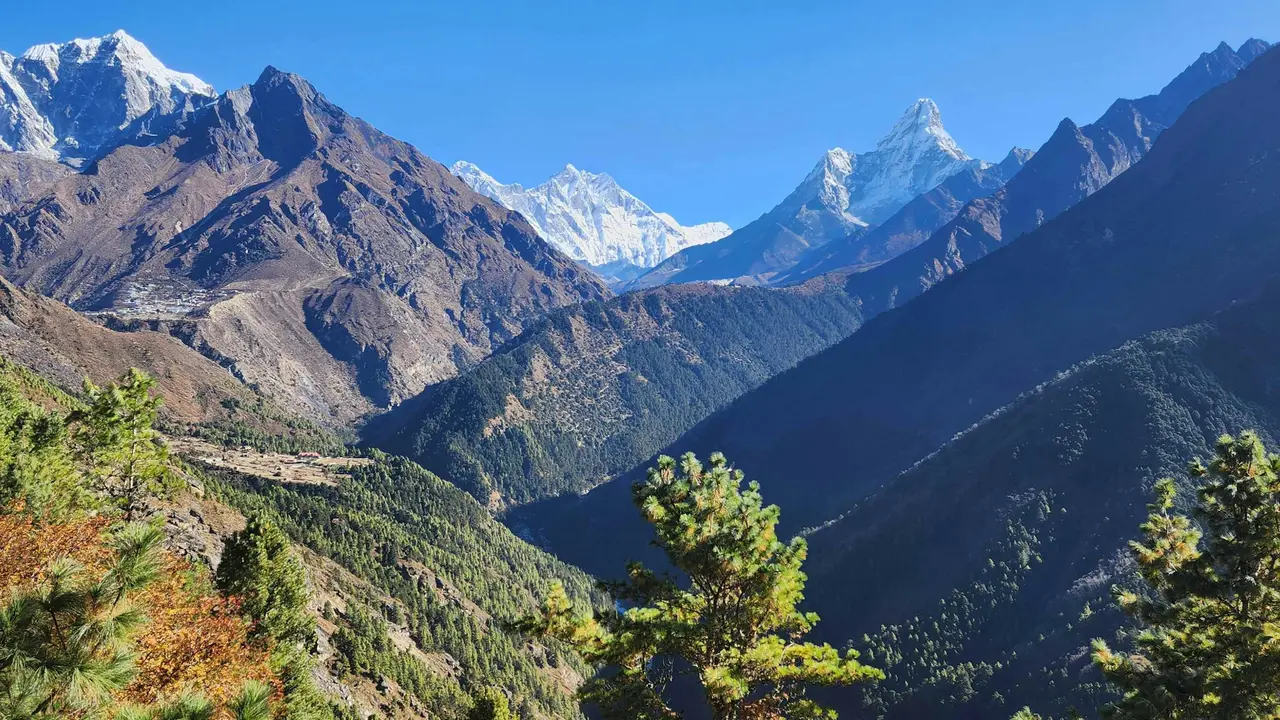
Everest region: NTC has a genuinely strong signal from Lukla through Namche Bazaar (~3,440 m) and on to Tengboche and Dingboche (4,410 m), thanks to towers positioned along the valley. Coverage weakens and becomes intermittent above Lobuche, and at Everest Base Camp (5,364 m) and Kala Patthar (5,644 m) it is unreliable — you may get a bar or two for a text message, rarely enough for a call. Ncell coverage on this route is patchier throughout and effectively absent above Dingboche.
Annapurna Circuit and Base Camp: NTC covers the lower and mid-valley villages well — Besisahar through Chame, and the Annapurna Sanctuary trail up to Machhapuchhre Base Camp — with a known dead zone through the high Manang villages before Thorong La (5,416 m) and a similar gap on the pass crossing itself. Ncell is workable in Manang town but drops out on the pass approach entirely.
Langtang Valley: Reasonable NTC coverage as far as Langtang village, weakening toward Kyanjin Gompa (~3,870 m), where it becomes intermittent rather than absent.
Manaslu Circuit and Upper Mustang (restricted areas): Both are remote enough that coverage is sparse and unreliable for long stretches; treat your phone as a bonus, not a plan, and carry a satellite messenger if you need a safety net here.
Teahouse wifi and the Everest Link cards
Teahouse wifi above the road-head almost never means free, unlimited internet — it usually means a prepaid card system, most famously Everest Link on the Khumbu (Everest) route, with a similar setup called NamgyalTsering or local hotspot cards elsewhere. You buy a scratch card from the lodge owner or a small kiosk, each one loaded with a data allowance (commonly sold in bands such as 500 MB, 1 GB or similar tiers), and you enter a code to connect a device for that allowance. Prices rise steeply with altitude — a card at Namche costs noticeably less than the same allowance at Gorak Shep, because the operator has to fly or portor every piece of equipment and its power supply up the valley.
The honest problem is reliability, not price. These systems run on solar power and satellite backhaul, both of which degrade in bad weather, at the end of a cloudy afternoon when batteries are low, or when too many trekkers in one lodge try to stream video simultaneously. Expect the connection to be workable for messaging and email in the morning and unusable by evening, and expect it to fail outright for a day or two during storms. Do not plan on a video call at altitude; plan on being able to send a short message once or twice a day, and treat anything more as a pleasant surprise.
Some lodges also offer their own private wifi router bundled into the room price at lower altitudes — this is more reliable than the card systems below about 3,500 m, but converges on the same shared-satellite bottleneck the higher you go.
eSIM options
An eSIM from a global reseller — Airalo, Holafly and similar services are the most commonly used for Nepal — lets you activate a Nepali data plan before you land, skip the airport queue, and keep your home SIM in the phone for calls and texts. This is genuinely useful if your phone supports eSIM (most iPhones from the XS onward and recent Android flagships do) and your trip is short and Kathmandu/Pokhara-weighted.
The honest limitation is that these eSIM plans run as data-only over the same NTC or Ncell infrastructure, and resellers do not disclose which underlying network they use route by route — so the mountain coverage gaps described above apply just as much to an eSIM as to a physical SIM, and you are paying a premium (often two to three times a local tourist SIM's cost for equivalent data) for the convenience of activating it before departure rather than for better reach. If you plan to trek above Namche or Manang, a physical NTC SIM bought locally will very likely outperform an eSIM for a fraction of the cost, and carrying both — eSIM for the city days, NTC physical SIM for the trek — is a reasonable middle path.
Power: charging, banks and solar
Charging your phone is a bigger constraint than data on most treks. Teahouses above the road-head charge a per-device, per-hour fee for mains charging — this varies by altitude and lodge and is worth checking before you plug in, since a phone left charging overnight can rack up an unexpectedly large bill relative to the room rate. A 10,000–20,000 mAh power bank, charged fully in Kathmandu or Pokhara before you start, comfortably covers a week of moderate phone use — camera, messaging, occasional map checks — and is the single most useful item for staying reachable without an daily lodge charging fee.
A foldable solar panel is worth carrying only on longer treks (Manaslu, the Everest Three Passes, Upper Mustang) where you may go several days above the last reliable charging point; for anything under two weeks on a standard teahouse route, a good power bank plus opportunistic mains charging is enough. Cold drains batteries faster than usual above 4,000 m, so keep your phone inside your jacket, close to body heat, when you are not actively using it, rather than in an outer pocket overnight.
FAQ
Which SIM is best for trekking in Nepal? NTC (Nepal Telecom) generally has the widest coverage on high trekking routes, with towers reaching well past Namche Bazaar and into the Annapurna mid-hills, while Ncell is faster in Kathmandu and Pokhara. Most trekkers heading above 3,000 m buy NTC as their primary SIM and treat anything else as backup.
Is there wifi at Everest Base Camp? Wifi access on the Everest route is patchy and runs through prepaid cards such as Everest Link, sold by lodge owners at each village. Reliability drops sharply with altitude and bad weather, so treat it as good for short messages rather than dependable connectivity, especially near Base Camp itself.
Can I use an eSIM in Nepal? Yes — resellers such as Airalo and Holafly sell Nepal data eSIMs that activate before you land and work well in Kathmandu and Pokhara. They run on the same underlying NTC or Ncell towers, so mountain coverage gaps are identical, and the data costs more than a local tourist SIM.
How much is mobile data in Nepal? A tourist SIM with a starter data-and-voice bundle typically costs in the range of NPR 500–1,500 (about USD 4–11) for roughly two weeks, though both carriers revise packages often — confirm the current price and validity at the counter before paying.
Hire the guide, not the agency
Connectivity questions like these — which SIM, whether the lodge wifi will hold, how you reach help if a call drops on a pass — are exactly the kind of ground-level detail an agency's marketing page never covers, because nobody at head office has stood at Thorong La with one signal bar. A NepGem guide has done the route in the season you're booking, knows which network holds past which village, and can tell you before you fly whether your planned trek needs a physical NTC SIM, a satellite messenger, or both.
That is the difference between hiring an agency and hiring the guide directly: with NepGem you see the guide's licence number, their altitude record on this exact route, the languages they speak, and reviews from trekkers who did the same trek — before you pay a deposit. There is no agency layer marking up the price or filtering what you're told about signal, safety, or the wifi that will or won't work at 4,900 m. You book the person who will actually be walking next to you, and you can ask them these exact questions before you commit.


