

Janakpur and the Mithila Terai: Sita's City That Tourism Forgot
यो कथा अहिलेलाई अङ्ग्रेजीमा मात्र उपलब्ध छ।
Janakpur has a marble temple, a living wedding festival and a women's painting tradition that predates most of Nepal's trekking trails — and almost no foreign visitors.
NepGem टोली · स्थानीय गाइड र यात्रा योजनाकार
· ११ मिनेट पढाइ

Janakpur sits in the flat farmland of the eastern Terai, roughly 28 km north of the Indian border at Jainagar, and it holds one of the busiest Hindu pilgrimage sites in the country alongside a textile-and-wall-painting tradition that has survived intact for generations. Almost none of the foreign trekkers who fly into Kathmandu each year will ever see it, because it sits nowhere near a mountain.
The Nepal nobody photographs
The honest starting point is a number: the Terai, the low, flat belt of plains running along Nepal's southern border with India, is home to roughly half of the country's population, and it receives a small fraction of the marketing attention that Everest, Annapurna and the Kathmandu Valley absorb between them. Trekking brochures, guidebook covers and Instagram feeds are built almost entirely on mountains, glaciers and terraced hillsides, which is a defensible choice commercially but a distorted one culturally. Nepal is not only a Himalayan country. It is also a Gangetic-plain country, hot and humid for much of the year, agricultural rather than alpine, and Hindu in a more continuous, unbroken way than the syncretic hill culture most visitors associate with the word "Nepali."
Janakpur, the largest city in Nepal's Madhesh Province and the historic capital of the ancient Mithila kingdom, is the clearest single place to see that other Nepal. It is flat, dusty in the dry months, genuinely hot from March through June, and entirely unconcerned with looking picturesque for a camera. It is also, by tradition, the birthplace of Sita, the co-protagonist of the Ramayana, and the site of one of the most architecturally distinctive temples in South Asia. None of this shows up if your itinerary only covers the routes most guidebooks push, which is exactly the gap this article exists to close. For context on where the Terai sits relative to Nepal's better-known geography, see the piece on how to identify Himalayan peaks from the hills further north — Janakpur is the plains counterpoint to everything in that article.
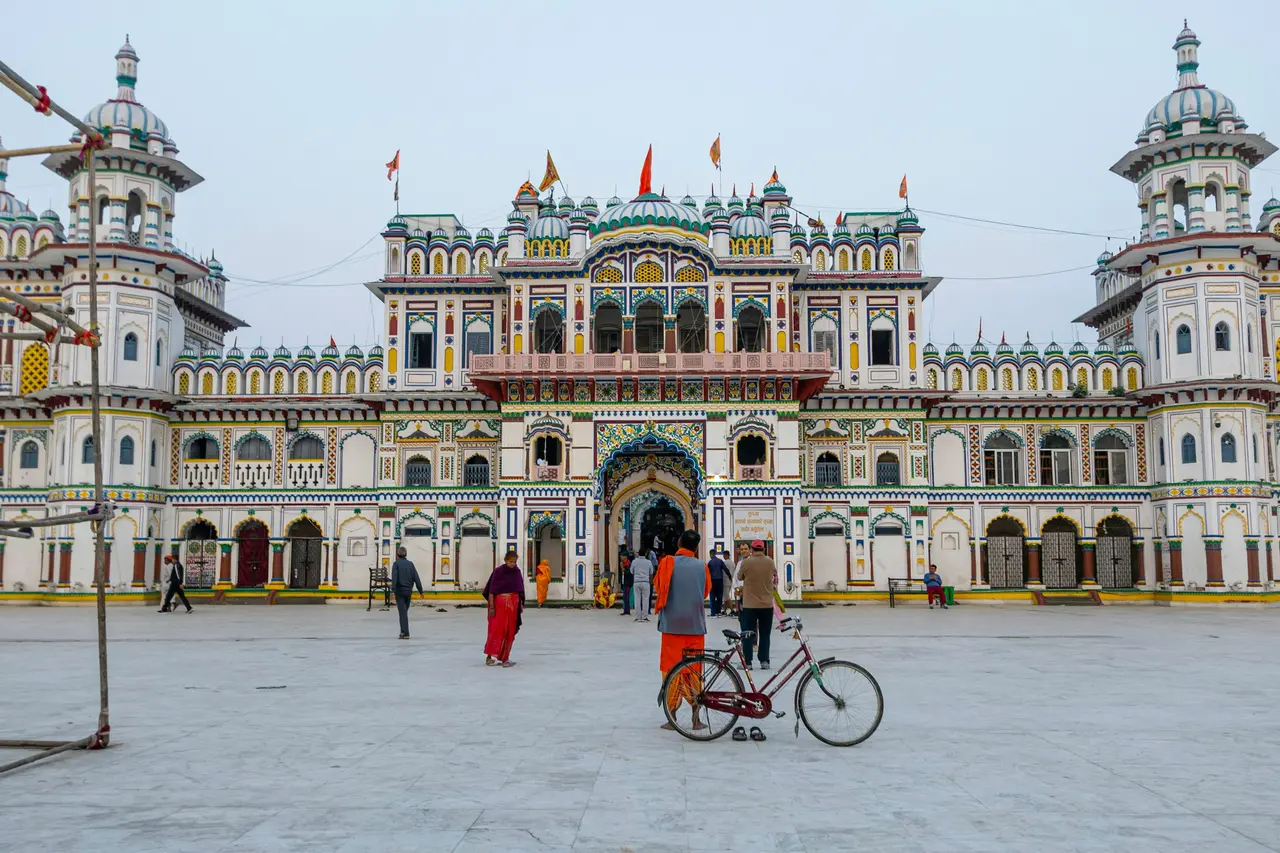
Janaki Mandir
The Janaki Mandir is a white marble temple built in 1911, commissioned by Queen Vrisha Bhanu of Tikamgarh in present-day India, and it is locally known as the Nau Lakha Mandir — the "nine-hundred-thousand-rupee temple," a reference to its construction cost in the currency of the day. Its architecture is a deliberate blend of Mughal and Rajput styles: domed spires, latticed marble screens, arched colonnades and a three-storey central structure that would look at home in Rajasthan rather than in a Nepali market town, which is precisely the point — it was built by an Indian royal patron for a shrine that both nations claim as sacred ground.
Inside, the temple houses images of Sita and Ram, and it functions as an active place of worship rather than a museum piece; visitors should expect queues of pilgrims, particularly around major festival dates, rather than a quiet heritage-site experience. The temple complex includes several inner courtyards and a scale that surprises most first-time visitors who arrive expecting a modest provincial shrine. Non-Hindu visitors are generally permitted into the outer courtyards and can view much of the architecture from there; access to the innermost sanctum is, as at most active Hindu temples in Nepal, restricted to worshippers, and this is worth confirming with a local guide before arrival rather than assuming either way. The building has been nominated for consideration on Nepal's UNESCO tentative list discussions alongside the country's seven confirmed UNESCO World Heritage Sites, though as of the 2026 season it remains a candidate rather than an inscribed property — a status worth checking before you cite it as a UNESCO site in any account of the visit.
Sita and the Ramayana connection
Janakpur's identity rests on a specific claim within the Ramayana: that this was Mithila, the kingdom ruled by King Janak, and that Sita — sometimes called Janaki, "daughter of Janak" — was found here as an infant in a furrow while the king ploughed a ritual field, which is also the traditional origin of her name, derived from the Sanskrit word for furrow. The epic goes on to place Ram and Sita's swayamvara, the contest in which Ram won Sita's hand by stringing and breaking Shiva's great bow, in this same city, making Janakpur the setting for one of the Ramayana's pivotal scenes.
It is worth being precise about what kind of claim this is. The identification of modern Janakpur with the Mithila of the Ramayana is a matter of long-standing religious and cultural tradition, reinforced by continuous pilgrimage and temple-building over centuries, rather than a settled matter of archaeological record; the exact historical geography of the ancient Videha-Mithila kingdom is debated among historians, and several sites across the Nepal-India border region carry related claims. None of this diminishes the city's significance to the millions of pilgrims, largely from Nepal's Madhesh region and India's Bihar state, who treat Janakpur as sacred regardless of the underlying historiography — but it is a distinction a careful visitor should hold onto rather than repeat the temple claim as settled fact. The city's temple network, and its role as a living centre of Hindu devotion shared across two countries, sits alongside Nepal's other major religious traditions covered in the piece on Hinduism and Buddhism in Nepal.
Mithila painting
Mithila painting, sometimes called Madhubani art after the Indian district where the same tradition flourishes, is a wall- and paper-based folk art form practised almost exclusively by women of the Maithil community across this Terai belt and the neighbouring Indian state of Bihar. Traditionally, the paintings were made directly on the mud-plastered walls and floors of homes, particularly in the kohbar ghar, the room prepared for a new bride, using pigments made from turmeric, rice paste, charcoal, flower petals and natural clays applied with twigs, brushes made from chewed bamboo, or fingertips. The subject matter draws heavily on Hindu mythology — Ramayana scenes, depictions of Krishna, the goddess Durga — alongside recurring motifs of fish, peacocks, the sun and moon, lotus flowers, and geometric border patterns, each carrying symbolic meaning tied to fertility, marriage and prosperity.
The tradition moved from domestic walls onto paper and canvas from the 1960s onward, largely as an income-generation response to drought and famine conditions in the region, and it is this paper-based, sellable form that most visitors encounter today. In Janakpur specifically, the Janakpur Women's Development Center, a cooperative founded in 1989, trains local women in the tradition and sells finished work, ceramics and textiles, with proceeds returning to the artists rather than to a middleman — it is a genuinely useful first stop for anyone wanting to buy responsibly rather than guess. The honest caution here is that Janakpur's market stalls and roadside vendors also carry mass-produced prints with no connection to a named artist or cooperative, sold at tourist-inflated prices as if they were originals; buying through a recognised cooperative, or asking directly who painted a piece and where the proceeds go, is the only reliable way to avoid paying original-art prices for a machine print.
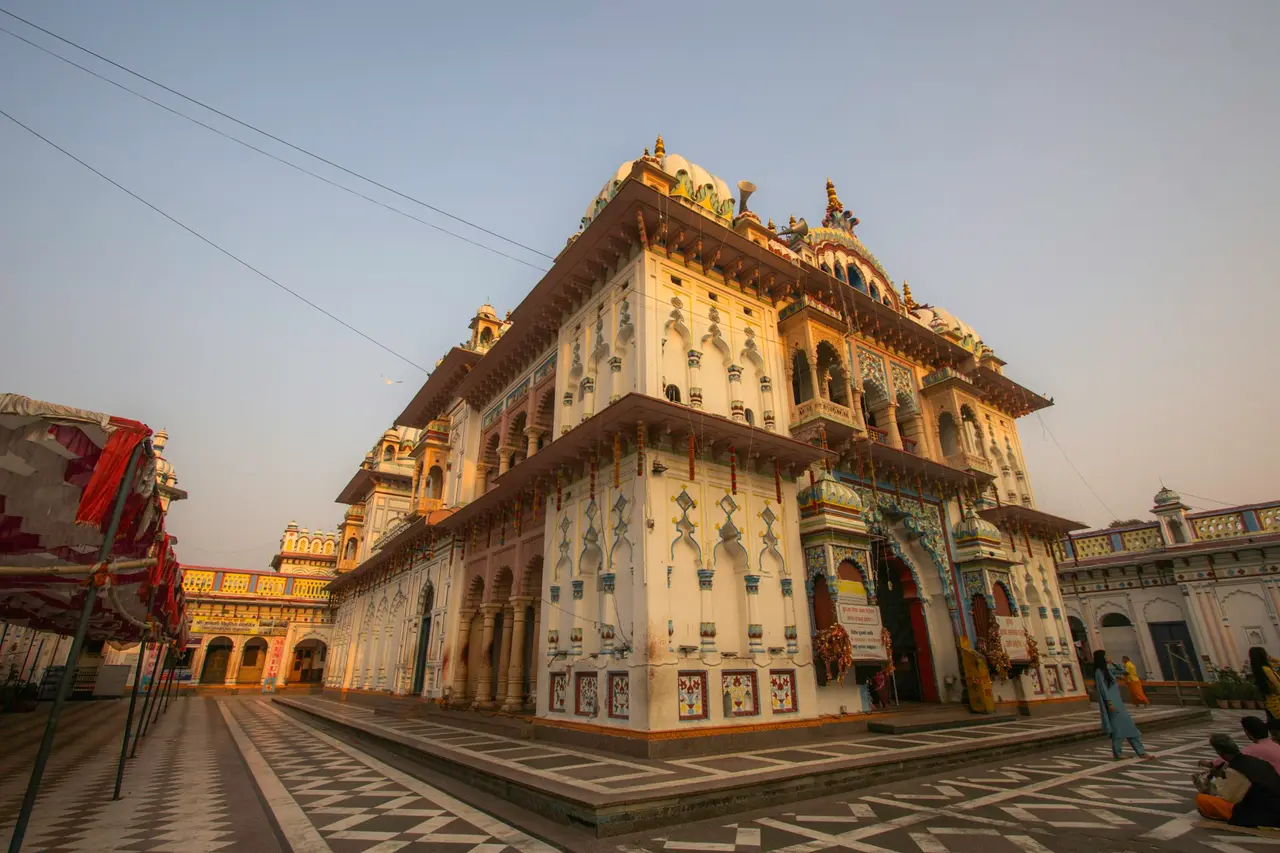
Vivaha Panchami
Vivaha Panchami is the annual festival marking the wedding anniversary of Ram and Sita, celebrated on the fifth day (panchami) of the lunar month of Margashirsha, which in the Gregorian calendar falls in November or December depending on the year. It is Janakpur's single biggest event, drawing large numbers of pilgrims from across Nepal's Madhesh region and, in greater numbers still, from India — particularly from Ayodhya, Ram's traditional birthplace, whose devotees travel to Janakpur specifically for this occasion in a mirror-image of the pilgrimage that runs the other way through the rest of the year.
The centrepiece is a formal wedding procession and re-enactment, staged with the full ceremonial trappings of a real Hindu wedding: a marriage party (barat) that processes through the old city, ceremonial dress, priests conducting the rites, and crowds that pack the lanes around the Janaki Mandir for several days around the main date. For a visitor, this is Janakpur at its most intense and most rewarding simultaneously — accommodation books out well in advance, the city's normal pace disappears under the crowd, and the atmosphere of genuine devotion rather than staged spectacle is difficult to find anywhere else in Nepal at this scale. Anyone planning a visit specifically for the festival should confirm the exact lunar date well ahead, since it shifts each year against the Gregorian calendar, and should book accommodation months rather than weeks in advance.
The sacred ponds and the old city
Janakpur's old city holds more than five dozen ponds, several of them considered sacred and directly tied to Ramayana episodes, of which Ganga Sagar and Dhanush Sagar, both close to the Janaki Mandir, are the most visited. Ganga Sagar in particular draws pilgrims for ritual bathing, and its stepped ghats and surrounding temple shrines make it one of the more photogenic corners of the old city outside the main temple itself. Walking the lanes around these ponds, rather than moving directly between temple and hotel, is where Janakpur's ordinary life becomes visible: sweet shops selling regional confections not found further north or west in Nepal, pilgrim rest houses (dharamshalas) built by wealthy patrons over the past two centuries, and a street rhythm shaped entirely by temple timings rather than tourist schedules.
The old city rewards slow walking over a checklist approach, and a half-day spent moving between the ponds, the temple precincts and the surrounding market lanes gives a far better sense of Janakpur than a rushed single stop at the Janaki Mandir alone.
Getting there and staying
Janakpur has its own domestic airport with short flights from Kathmandu, typically in the region of 30–40 minutes in the air, which is by far the fastest option and the one most short-stay visitors choose. By road, Janakpur sits on the Terai highway network roughly 6–8 hours from Kathmandu by private vehicle or tourist bus, longer by local bus, and it is also reachable from Birgunj and from the Indian border crossing at Jainagar for anyone routing through from India. See the fuller comparison of getting around Nepal for realistic journey times on both the flight and road options.
Accommodation in Janakpur is modest rather than boutique: a handful of mid-range hotels serve pilgrims and the occasional foreign visitor, alongside a larger stock of budget guesthouses and dharamshalas aimed at Hindu pilgrims travelling on tighter budgets. Do not expect Pokhara-level lakeside comfort or Kathmandu's range of international-standard hotels; book ahead around Vivaha Panchami specifically, since that is when the city's limited room stock disappears fastest, and treat air conditioning as a genuine necessity rather than a luxury during the hot pre-monsoon months.
FAQ
What is Janakpur famous for? Janakpur is identified in Hindu tradition as the birthplace of Sita and the capital of the ancient Mithila kingdom described in the Ramayana. It is home to the Janaki Mandir, a distinctive white marble temple built in 1911, and to the Mithila painting tradition practised by Maithil women across the surrounding Terai region.
Where can I buy Mithila paintings? Buy through a recognised cooperative such as the Janakpur Women's Development Center rather than an unnamed roadside stall, since proceeds return directly to the artists and the work is genuinely hand-painted. Ask who made a piece and where the money goes; mass-produced prints sold as originals are common in the tourist market.
When is Vivaha Panchami? Vivaha Panchami falls in November or December, on the fifth day of the lunar month of Margashirsha, and the exact Gregorian date shifts each year. It marks Ram and Sita's wedding anniversary with a large ceremonial procession and re-enactment through Janakpur's old city.
How do you get to Janakpur? The fastest route is a short domestic flight from Kathmandu, around 30–40 minutes in the air. By road it is roughly 6–8 hours from Kathmandu on the Terai highway network, and Janakpur is also reachable from the Indian border crossing at Jainagar for travellers routing through India.
Beyond the temple: taking a guide who knows Mithila culture, not just the mountains
Most of the guiding infrastructure built for Nepal is built for the Himalaya — altitude experience, pass conditions, high-camp logistics. Janakpur needs a different kind of local knowledge: which festival dates matter, which cooperative genuinely pays its artists, when it is appropriate to enter a temple courtyard and when it is not, and how to read a city whose rhythms are set by Hindu ritual calendar rather than trekking season. NepGem's guide-hire model was built for the mountains, but the underlying principle travels: see a guide's profile, their language skills, their reviews and their actual experience in a region before you commit, rather than trusting an unnamed fixer arranged through a hotel desk. If your Nepal trip already includes a Himalayan trek booked or joined through NepGem, ask your guide directly whether they know a vetted local contact for the Terai leg — it is the same "verify before you pay" principle that makes hiring a mountain guide through NepGem different from booking through an anonymous agency in the first place.


