

Yala Peak: The Best First Summit in Nepal
यो कथा अहिलेलाई अङ्ग्रेजीमा मात्र उपलब्ध छ।
A real 5,732 m summit in 10 days from Kathmandu, no flight, no crevassed glacier. Route, skills, permits and honest cost for Nepal's easiest climbing peak.
NepGem टोली · स्थानीय गाइड र यात्रा योजनाकार
· ११ मिनेट पढाइ

Co-authored with an NMA-licensed climbing guide (licence no. on file) · Last verified: September 2026
Yala Peak, at 5,732 m in the Langtang valley, is widely considered the least technical climbing peak in Nepal: a snow slope reached without a flight, without crevassed glacier travel, and without the fixed-line headwalls that define Island Peak or Mera Peak. It is still a real climb, not a hard walk, and it still needs basic crampon and rope skills at real altitude. If you have not settled on Yala over another first summit, peak climbing in Nepal ranks the full ladder of trekking peaks by difficulty, and the Langtang Valley trek covers the approach route this climb is built on, in more detail than the itinerary below.
Why Yala is the right first summit
Yala earns its reputation as Nepal's best first summit because it strips away every variable that makes other trekking peaks harder without removing the thing that actually matters: standing on a genuine 5,000 m-plus summit under your own effort. There is no crevassed glacier to rope across, no roughly 100 m fixed headwall like Island Peak's, and no flight-dependent approach like Lukla adds to Everest-region peaks; you drive to Syabrubesi and walk in.
What Yala does keep is everything that makes a first summit worth doing properly: a genuine snow slope near the top steep enough to need crampons and a rope, a summit at real altitude where thin air and cold are not theoretical, and an honest test of whether higher, harder peaks are something you actually want to pursue. Climbers who complete Yala competently and comfortably have a real, on-mountain answer to that question, rather than a guess based on a hard trek alone.
Some larger expeditions bound for harder Himalayan objectives, including Shishapangma across the Tibetan border, also use Yala as a short, low-risk acclimatisation and skills shakedown before committing to a longer, more serious mountain, which says something about how the mountaineering community itself rates the peak: technically modest, but genuinely useful as a real-altitude test rather than dismissed as a token summit.
Day-by-day: 10 days via Langtang
A realistic Yala Peak itinerary from Kathmandu runs ten days, including a built-in contingency day for weather, and it never uses a domestic flight.
| Day | Route | Altitude |
|---|---|---|
| 1 | Kathmandu to Syabrubesi (drive) | 1,460 m |
| 2 | Syabrubesi to Lama Hotel | 2,380 m |
| 3 | Lama Hotel to Langtang village | 3,430 m |
| 4 | Langtang village to Kyanjin Gompa | 3,870 m |
| 5 | Acclimatisation day at Kyanjin Gompa (side hike to Tserko Ri or Kyanjin Ri) | 3,870 m (day hike to ~4,600–5,000 m) |
| 6 | Kyanjin Gompa to Yala Base Camp | ~4,900 m |
| 7 | Summit Yala Peak, return to Base Camp or descend to Kyanjin Gompa | 5,732 m |
| 8 | Contingency day (weather buffer, unused days become extra rest) | — |
| 9 | Kyanjin Gompa to Syabrubesi | 1,460 m |
| 10 | Syabrubesi to Kathmandu (drive) | — |
The first four days are pure valley trekking along the Langtang river, through rhododendron and pine forest below Lama Hotel, crossing several suspension bridges over glacial side-streams, and opening into increasingly wide, glacier-carved terrain above Langtang village, with no technical ground at all. Langtang village itself was almost entirely destroyed by a landslide triggered by the 2015 Gorkha earthquake, and the community has rebuilt on the same site with visibly newer teahouses than you will see in older, unaffected villages further down the valley; walking through it is a quieter, more sobering part of the trek than most itinerary descriptions mention.
Day 5's acclimatisation hike to Tserko Ri (around 4,984 m) or the shorter Kyanjin Ri viewpoint is not optional padding; it is the single most important day for reducing your risk of altitude sickness on summit day two days later, and skipping it to save a day is the most common mistake made on this itinerary. Day 8 is a genuine reserve day, not a scenic extra: build it into your schedule and flight bookings home so that a poor-weather summit window on Day 7 does not force a rushed, riskier attempt.
Summit day
Summit day starts in the dark from Yala Base Camp at around 4,900 m, typically leaving between 2 and 4 a.m. so that the summit and the descent back across softening snow both happen before the afternoon's usual cloud build-up. The route climbs scree and moraine to the snowline, where the group ropes up and switches to crampons for a snow slope generally in the 30–40° range, moderate by mountaineering standards but entirely serious at over 5,000 m in the cold and dark.
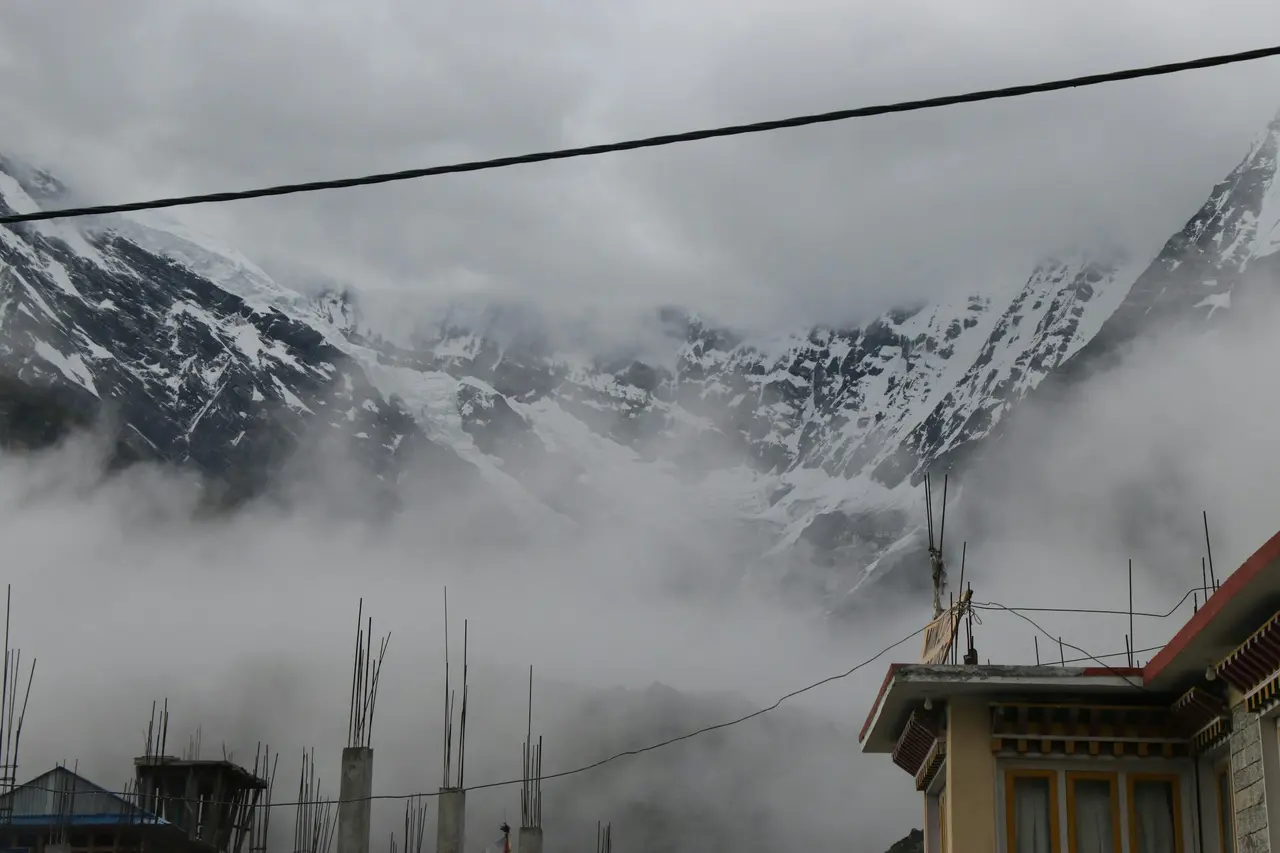
The final stretch runs along a broad summit ridge to Yala's true summit at 5,732 m, where clear-weather views take in Shishapangma (8,027 m, one of the fourteen 8,000 m peaks, visible across the Tibetan border) and the dramatic ice-fluted face of Langtang Lirung (7,227 m) close by to the south. Most teams descend the same day, either back to Base Camp or, conditions and energy permitting, all the way down to Kyanjin Gompa, turning a demanding but single long day into the itinerary's hardest push rather than a multi-day ordeal.
Do not mistake the moderate slope angle for low seriousness. A slip on a 30–40° snow slope at 5,700 m, roped or not, is exactly the kind of incident self-arrest training exists for, and cold, fatigue and thin air all degrade judgement and reaction time well before they become obviously dangerous. The descent carries its own, less-discussed risk: by mid-morning, sun on the slope softens the snow surface, which slows footing and increases the chance of a post-holed step turning an ankle rather than causing a fall, which is the main reason guides push for such an early start rather than a more comfortable daylight departure. This is a real climb with real consequences for carelessness, not a scenic hike with a rope attached for reassurance.
Skills and gear
Yala's technical demands are genuinely modest compared with Island Peak or Mera Peak, but "modest" still means specific, non-negotiable skills, not none. You need basic crampon technique on moderate snow, comfort moving roped to a guide or short rope team, and a working self-arrest reflex with an ice axe, all of which can be taught and practised on a pre-climb skills day near Base Camp for a climber with no prior technical experience, provided they arrive reasonably fit.
Gear needs are correspondingly simple: crampons fitted to your boots in advance, a general mountaineering ice axe, a climbing harness, a helmet for the summit slope, and cold-weather layering rated to roughly -20°C for the pre-dawn start, since temperatures at 4,900–5,732 m before sunrise regularly fall well below freezing even in the main spring and autumn climbing seasons. Unlike Island Peak or Mera Peak, you do not need a jumar, a descender for a fixed line, or crevasse-rescue equipment, because Yala's route crosses no crevassed glacier and uses no fixed headwall.
Boot compatibility is worth checking before you fly, not after: crampons need a semi-rigid or rigid mountaineering boot with a welt or compatible sole, not a standard trekking boot, and a boot that has never been tested with its crampons before summit morning is a common, entirely avoidable source of delay and blisters. A reputable operator will also cap the number of climbers per guide on summit day, typically no more than three or four clients to one climbing guide on the roped section, since that ratio is what actually allows a guide to manage pacing, rope tension and an early symptom of altitude sickness across the whole group rather than just the person nearest them.
Permits: NMA Group B
Yala Peak is classified by the Nepal Mountaineering Association as a Group B trekking peak, the lower of the two trekking-peak fee categories, which keeps its permit costs meaningfully below Group A peaks and far below a technical expedition peak's fees. On top of the NMA climbing permit, you also need a Langtang National Park entry permit, since the entire approach and the peak itself sit inside the park's boundaries, and a refundable garbage-deposit is standard practice for any NMA-permitted climb in the region.
None of these fees are fixed for all time; the NMA and Nepal's Department of National Parks and Wildlife Conservation both revise schedules periodically, and Group B fees in particular have historically been adjusted for group size and season. Confirm current figures with your operator or directly against NMA and DNPWC schedules before budgeting, rather than treating any number quoted here or elsewhere as locked in.
A licensed climbing guide is a legal requirement for an NMA-permitted peak like Yala, not an optional convenience, and this is separate from and in addition to the general trekking-guide requirement now in force for Nepal's national parks and conservation areas. The peak permit itself is issued in the guide or operator's name against the group, which is one practical reason independent, unguided climbing attempts on any NMA peak are both illegal and, in practice, almost never arranged.
Cost
A realistic 10-day Yala Peak trip from Kathmandu, including the NMA Group B and national park permits, a climbing guide, porter support, teahouse lodging and food, and shared ground transport to and from Syabrubesi, typically runs in the low-to-mid thousands of US dollars per person on a private booking, falling meaningfully once fixed costs are shared across a fuller group.
The costs that split across a group are the climbing guide's fee, the jeep or bus to and from Syabrubesi, and the group climbing-permit administration; the costs that do not split are your own park entry fee, teahouse lodging and food, and any personal gear rental. That is exactly the arithmetic NepGem's group departures are built around: the fixed pool shrinks per person as more climbers join the same departure date, while what you were always going to pay individually stays the same regardless of group size.
Yala Peak: price by group sizeFAQ
How hard is Yala Peak? Yala is widely considered the least technical climbing peak in Nepal, involving a snow slope with basic crampon and rope skills at 5,732 m rather than crevassed glacier travel or a fixed-line headwall. It is still a real climb requiring genuine altitude fitness and careful judgement, not a hard walk.
Do you need experience for Yala Peak? No prior technical climbing experience is required, since the skills involved, crampon technique, roped movement and self-arrest, can be taught on a pre-climb skills day near Base Camp. You do need solid trekking fitness at altitude and a willingness to take the acclimatisation schedule seriously.
How long does it take? A full Yala Peak trip from Kathmandu runs ten days including a contingency day for weather, with four days of valley trekking, one acclimatisation day, one day to Base Camp, one summit day, and two travel days. Shorter itineraries exist but remove the buffer that protects against a missed summit window.
Is Yala Peak a real climb? Yes. Reaching 5,732 m requires roping up, using crampons on a genuine 30–40° snow slope, and managing real cold and altitude before dawn, even though the technical grade is lower than Island Peak or Mera Peak. It is a legitimate first mountaineering summit, not a scenic walk with a rope for effect.
Arrive solo, summit with a group already booked on the date
Yala Peak is one of the easiest trekking peaks to join rather than book privately, because its short, flight-free itinerary makes fixed departure dates genuinely reliable. NepGem's Yala Peak departures let you arrive solo and climb with a group that already has people on it, with the shared costs above split live across whoever has already joined, rather than negotiating a private climbing guide alone or waiting for a group to form before a date is confirmed. If you would rather build your own dates around a work schedule or a longer Langtang itinerary, the same licensed climbing guides are available to hire directly, with their NMA licence number and altitude record visible before you pay either way. From here, learning the skills before you climb and Island Peak are the natural next steps once Yala is behind you.


