

Ama Dablam: The Matterhorn of the Himalaya
Ama Dablam's south-west ridge is a genuine technical alpine climb, not a trekking peak — the grades, the camps, the fees and the risk, stated plainly.
NepGem team · Local guides and trip planners
· 14 min read

Co-authored with an NMA-licensed climbing guide (licence no. on file) · Last verified: September 2026
Ama Dablam, at 6,812 m, is a genuine technical alpine climb, not a trekking peak, and the distinction matters more than its modest height suggests: the standard south-west ridge route involves sustained rock to around UIAA grade 5.7-equivalent and steep fixed-line ice and snow, which puts it in an entirely different category from Island Peak or Mera Peak. It sits under Nepal's Department of Tourism expedition-peak regime rather than the Nepal Mountaineering Association's trekking-peak system, with a different permit structure, a longer expedition timeline, and a genuinely higher level of prerequisite alpine experience expected of anyone on the rope. If you have not yet looked at Nepal's full range of climbable peaks, the peak-climbing overview is the place to work out where a mountain like this sits relative to an easier first climb.
This guide sets out why Ama Dablam sits in a different category, the south-west ridge camp by camp, the technical grades behind the route, the permit and expedition fee structure, the season and fixed-rope window, what an expedition actually costs, and the objective hazards stated plainly rather than glossed over.
 [GEN]
Why Ama Dablam is a different category
Ama Dablam is expedition climbing, not peak climbing, and that distinction should shape every decision you make about preparing for it. Where Island Peak or Mera Peak ask for competent use of a jumar on a fixed rope and solid crampon technique, Ama Dablam's south-west ridge demands genuine rock-climbing ability on exposed terrain, comfort leading or seconding pitches at altitude in bulky clothing and mountaineering boots, and prior experience on routes graded Alpine AD (Assez Difficile) or D (Difficile) in your home ranges before you arrive in Nepal.
This is not gatekeeping for its own sake. The route's Yellow Tower and Grey Tower pitches, described in detail below, are rock climbing in every meaningful sense, just at 6,000 m rather than sea level, in a down suit and stiff boots rather than rock shoes. A climber whose only prior experience is trekking peaks with fixed ropes and jumars will find themselves genuinely out of their depth on these pitches, and a responsible guide will say so during the vetting conversation before booking rather than after you have paid a non-refundable deposit. Serious operators run a pre-expedition assessment, sometimes a short technical day near base camp, precisely to catch this mismatch before the team commits to the higher camps.
The name "the Matterhorn of the Himalaya" is not just a marketing line; it describes something real about the mountain's shape and the climbing it demands. Like the Matterhorn, Ama Dablam is a striking, near-symmetrical rock-and-ice pyramid that looks technical from every angle because it is technical from every angle, unlike a broad-shouldered trekking peak with one obvious walk-up line. Guidebooks and expedition operators that describe Ama Dablam as "non-technical" or "suitable for first-time climbers" are, in the honest assessment of guides who have actually led it, describing a different mountain. The confusion often comes from conflating Ama Dablam with genuinely non-technical trekking peaks that share a region or a similar altitude on paper; the numbers on a map do not capture what the rock and ice on this specific ridge actually demand.
The south-west ridge, camp by camp
The standard route follows the south-west ridge from base camp at around 4,600 m to the 6,812 m summit across three high camps, each with its own defining technical character.
Base Camp to Camp 1 (around 5,700 m) climbs steep, loose scree and rock slabs above base camp, non-technical but sustained and exposed, gaining roughly 1,100 m. This section is largely fixed-roped in its steeper upper sections during the climbing season.
Camp 1 to Camp 2 (around 5,900–6,000 m) is where the route turns genuinely technical, crossing the Yellow Tower, a distinctive band of yellow-orange rock requiring sustained climbing on fixed ropes, ascended with a jumar but demanding real balance and footwork on rock rather than the ice-axe-and-crampon technique used lower down. This pitch alone rules out anyone without rock-climbing background.
 [PHOTO]
Camp 2 to Camp 3 (around 6,300 m) is widely regarded as the technical crux of the whole route, crossing the Grey Tower, a steeper and more sustained rock band than the Yellow Tower, and the famous Mushroom Ridge: a narrow, corniced snow-and-ice crest overhung with bulbous, mushroom-shaped ice formations, requiring careful, deliberate movement with real exposure on both sides. Camp 2 itself is a cramped, exposed ledge camp, and Camp 3, perched on a snow shoulder below the final summit slopes, is used only briefly before the summit push because of its exposure to wind and rockfall.
 [PHOTO]
Camp 3 to the summit climbs a final, steep snow-and-ice slope, typically fixed-roped, to the summit ridge and the distinctive hanging glacier ("the dablam", the ornament that gives the mountain its name) visible below the true summit on the south face. Summit day from Camp 3 typically runs 8–10 hours round trip, shorter than a full-length trekking-peak summit day but at a higher overall technical standard throughout.
Base camp itself, at around 4,600 m in a broad meadow below the mountain's south-west face, is a genuine tent city in the autumn season, with multiple expedition operators running parallel rotations and a shared rope-fixing effort coordinated between them. Climbers typically make two or three rotations between base camp and the higher camps before the summit push, each rotation building acclimatisation and familiarity with the fixed lines, rather than a single continuous push from base camp to summit as on some shorter trekking peaks. A rotation to Camp 1 or Camp 2 and back, resting a night or two at base camp afterwards, is standard practice, and skipping these rotations to save time is a common and dangerous shortcut some budget operators take under schedule pressure.
 [GEN]
Technical grades and the skills behind them
The south-west ridge is typically graded Alpine AD+ to D-, with individual rock pitches on the Yellow and Grey Towers reaching roughly UIAA III–IV (comparable to around 5.6–5.7 in the Yosemite Decimal System), climbed in mountaineering boots and often gloves, which makes the effective difficulty considerably higher than the same grade would feel at a rock crag in trainers.
The skills this demands, beyond what a trekking peak requires: genuine rock-climbing movement — footwork, balance, weight transfer — on exposed terrain in bulky gear; multi-pitch fixed-rope technique including safe transitions between rope sections and around anchors; comfort with sustained exposure over multiple consecutive days rather than a single summit push; and the judgement to manage your own pace and rest across a longer, more physically demanding rotation between camps than a trekking-peak itinerary requires. Most serious operators expect climbers to have completed at least one prior Alpine AD-grade route, ideally with mixed rock and ice, and many also expect prior experience on a 6,000 m peak such as Island Peak or Mera Peak as an altitude baseline before attempting Ama Dablam specifically.
None of this is optional polish. Climbers who arrive without this background are the ones most likely to become a liability to their own rope team on the Yellow Tower or the Mushroom Ridge, precisely the sections where a slow, unsteady climber creates real risk for everyone queued behind them on a single fixed line.
A useful, honest self-check before you book: if the hardest rock pitch you have led or seconded is a via ferrata or a heavily bolted sport climb, Ama Dablam's Yellow Tower will feel like a significant step up, not a comparable challenge at altitude. If instead you have climbed multi-pitch alpine rock routes in mountain boots, ideally with some winter or mixed mileage, the transition to doing the same movement at 6,000 m with less oxygen is a real adjustment but a manageable one. Reputable operators will ask about this history in detail during booking, not as a formality but because the answer genuinely changes whether they will take your booking at all.
Permit and expedition fees
Ama Dablam sits under Nepal's Department of Tourism expedition-peak system rather than the NMA's trekking-peak category that governs Island Peak and Mera Peak, and the fee structure reflects that: a government royalty fee for the peak, a mandatory liaison officer assigned to the expedition, garbage-management and environmental deposit requirements, and separate fees for base camp use and communications equipment. As of the 2026 season, verify the current fee schedule directly with Nepal's Department of Tourism or a registered expedition operator, since expedition-peak royalties and associated fees are set and revised separately from the NMA's trekking-peak schedule and have been adjusted in recent years.
| Fee category | What it covers |
|---|---|
| Government royalty (DoT) | Per-expedition or per-climber fee to climb the peak, season-dependent |
| Liaison officer | Mandatory government representative attached to the expedition |
| Garbage/environmental deposit | Refundable deposit tied to waste removal from base camp and higher camps |
| Base camp and communications fees | Separate charges for base camp establishment and radio/satellite use |
This is meaningfully more bureaucratic than booking an NMA trekking-peak permit, and it is one reason Ama Dablam expeditions are typically organised through an established expedition operator rather than arranged informally, even for experienced climbers who might otherwise consider a lighter-touch, self-organised trip on a trekking peak.
Season and the fixed-rope window
Ama Dablam is climbed almost exclusively in the post-monsoon autumn window, roughly late September through November, when a rotating team of Sherpa climbers, often coordinated across the season's operators, fixes rope along the standard route from base camp to the summit. A smaller, less reliable spring window exists but sees far fewer ascents because of less stable snow and ice conditions on the ridge.
Outside the window when fixed ropes are in place, the route reverts to a serious, largely unsupported alpine undertaking suited only to genuinely expert independent climbers, not to guided clients. Booking a date within the established autumn fixed-rope season, and confirming with your operator that the rope-fixing team has actually completed the route before your summit push, is not a minor scheduling detail; it is the difference between climbing a well-protected route and an unprotected one at grade AD+/D-.
The autumn window itself is not uniformly good throughout its length. Early season dates in late September can still carry monsoon-leftover snow loading on the upper ridge, which increases avalanche and rockfall risk until it consolidates or sheds; late-season dates into December bring colder temperatures and shorter daylight hours that compress an already long summit day. Most experienced operators cluster their summit pushes in a fairly narrow mid-October to mid-November band for this reason, and a date offered well outside that band is worth questioning rather than assuming it is simply a quieter, less crowded option.
What it costs, and where the money goes
A guided Ama Dablam expedition typically costs USD 6,000–12,000 per person depending on operator tier, group size and service level, substantially more than an NMA trekking peak because of the longer timeline, the DoT fee structure, the higher Sherpa-to-climber ratio needed on technical terrain, and the extended rope-fixing and camp-support operation the route requires.
| Cost item | Approximate range (USD) |
|---|---|
| DoT royalty, liaison officer, deposits and base camp fees | Verify current DoT fee schedule |
| Climbing Sherpa and guide fee (higher ratio than trekking peaks) | 2,500–4,500 |
| Base camp services, food, oxygen contingency | 1,500–2,500 |
| Domestic flights and approach trekking costs | 500–800 |
| Rescue and evacuation insurance (higher cover required) | 300–500 |
The Sherpa and guide fee line is proportionally larger here than on a trekking peak because the ratio of experienced climbing staff to clients on technical rock pitches is necessarily higher; a team stretching one climbing Sherpa across too many clients on the Yellow Tower is a fee-cutting decision with a direct safety cost, not an efficiency gain.
Objective hazard, stated plainly
Ama Dablam carries genuine objective hazard beyond the technical difficulty of the climbing itself, and this section exists because too many summaries of the mountain skip straight from "beautiful" to "doable" without naming what actually goes wrong. Rockfall on the lower slopes below Camp 1, especially once the day warms and freeze-thaw cycles loosen debris, is a real and recorded hazard, which is part of why the route is typically climbed with an early start each day. Camp 2's exposed ledge position and Camp 3's exposure to wind mean camp itself carries risk, not just the climbing between camps; high winds have forced retreats and, on rare occasions, contributed to serious incidents at these camps historically. The Mushroom Ridge's corniced snow formations are inherently unstable structures, and a guide's judgement about which side to pass a given mushroom on, and how much weight to trust a given section of cornice, is exactly the kind of call that separates an experienced Ama Dablam guide from a generically qualified one.
None of this means the mountain should be avoided. It means it should be climbed with a guide who has led it multiple times, in the established autumn fixed-rope window, with a team whose Sherpa-to-climber ratio reflects the technical demand rather than a budget target, and with your own prior alpine experience genuinely matching what the route asks of you. A climber who arrives properly prepared, on a well-run expedition, faces a level of risk that is well understood and consistently managed by experienced teams season after season; the danger comes overwhelmingly from mismatches between preparation and route, not from the mountain being inherently unclimbable.
FAQ
How hard is Ama Dablam? Ama Dablam is a technical alpine climb at 6,812 m, with rock pitches to around UIAA III–IV (roughly 5.6–5.7-equivalent) and steep fixed-line ice on the south-west ridge. Prior experience on Alpine AD-grade routes is expected; it is a different category of difficulty from an NMA trekking peak.
How much does an Ama Dablam expedition cost? A guided Ama Dablam expedition typically costs USD 6,000–12,000 per person, covering Department of Tourism fees, a higher Sherpa-to-climber ratio for the technical pitches, base camp services, and insurance rated for a technical high-altitude rescue.
How long does it take? A full Ama Dablam expedition, including acclimatisation trekking, camp rotations and a weather-dependent summit window, typically runs three to four weeks from arrival in Kathmandu to descent, longer than a trekking-peak climb because of the technical rotation schedule and rope-fixing timeline.
Is Ama Dablam harder than Everest? Technically, yes. Ama Dablam's south-west ridge involves sustained rock and steep mixed climbing that the standard Everest South Col route does not; Everest's difficulty instead comes from extreme altitude, the Khumbu Icefall, and the sheer duration of exposure to the death zone. See what climbing Everest actually costs and demands for the fuller comparison.
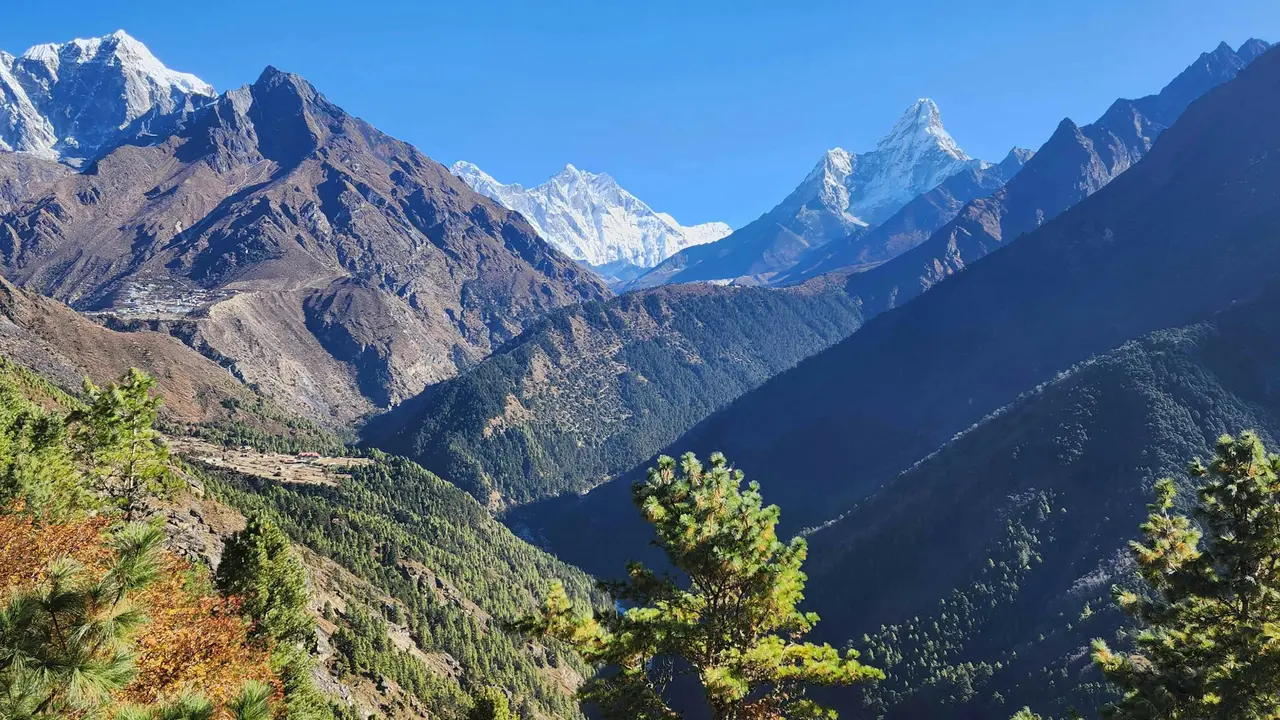
Ama Dablam's unmistakable silhouette, visible from the main Everest Base Camp trail for days before you reach Tengboche, is also one of the easiest Himalayan giants to identify by shape alone once you know its distinctive hanging glacier and twin-summit profile.
Hire the guide who has actually led the south-west ridge
Ama Dablam's risk sits in details a brochure will not spell out: how many times the guide has personally led the Yellow and Grey Towers, whether the team's Sherpa-to-climber ratio matches the technical demand, and whether they will honestly tell you before departure if your alpine background does not yet match the route. NepGem's climbing guide profiles show licence numbers, documented ascents on technical peaks including Ama Dablam, and past-client reviews before you commit a deposit, so you can check a specific guide's track record on this specific route rather than trusting an operator's marketing copy. Hire that guide directly, and have the AD-grade prerequisite conversation honestly before you book, not on the Yellow Tower.


