

Thamel, Kathmandu: How to Use It Without Being Fleeced
Thamel is Kathmandu's gear district and nightlife strip in one square kilometre. Here is how to buy right, eat well and skip the tourist mark-up.
NepGem team · Local guides and trip planners
· 13 min read

Thamel is the half-square-kilometre grid of lanes north of Kathmandu's old royal palace where almost every trekker in Nepal spends at least one night. It is not a historic neighbourhood in the way Kathmandu's Durbar Square is; it is a service district that grew up around the overland and trekking trade from the 1970s onward, and it does one job extremely well: it sells you everything you need for the mountains inside a fifteen-minute walk. The job of this guide is narrower than "things to do in Thamel." It is: how do you use this district without paying triple for fake gear, eating badly, or losing an evening to a tout. For the wider city, start with the Kathmandu travel guide; this page stays inside Thamel's lanes.
What Thamel is for
Thamel exists to outfit and feed travellers moving in and out of the mountains, and to entertain them for the one or two nights either side of a trek. Its lanes run between Kantipath in the east, Tridevi Marg in the south, and the quieter residential edge of Lazimpat to the north, with the busiest cluster around Thamel Chowk, Jyatha and Paryatan Marg. Inside that grid: several hundred gear shops and trekking agencies, budget-to-boutique guesthouses stacked three and four storeys high, bakery cafés serving cinnamon rolls to people about to eat rice and lentils for two weeks, bookshops selling secondhand trekking memoirs, and a nightlife strip that runs later than anywhere else in the Kathmandu Valley. It is loud, it is commercial, and it is honest about being commercial in a way that makes it easier to navigate once you understand the rules rather than resent them. Most first-time visitors give Thamel a day for gear and errands before heading into the hills, and a night or two afterwards to decompress before flying home; that rhythm is the right one, and it is the reason where to stay in Kathmandu treats a pre-trek and post-trek stay as two different problems. Thamel's shopfronts also double as the district's practicality counter: local SIM stalls sit between the gear shops for travellers sorting out a Nepal SIM card on day one, and most guesthouses can point you to the nearest immigration counter if any part of your Nepal visa on arrival paperwork still needs finishing.
Gear shopping: genuine, licensed and fake
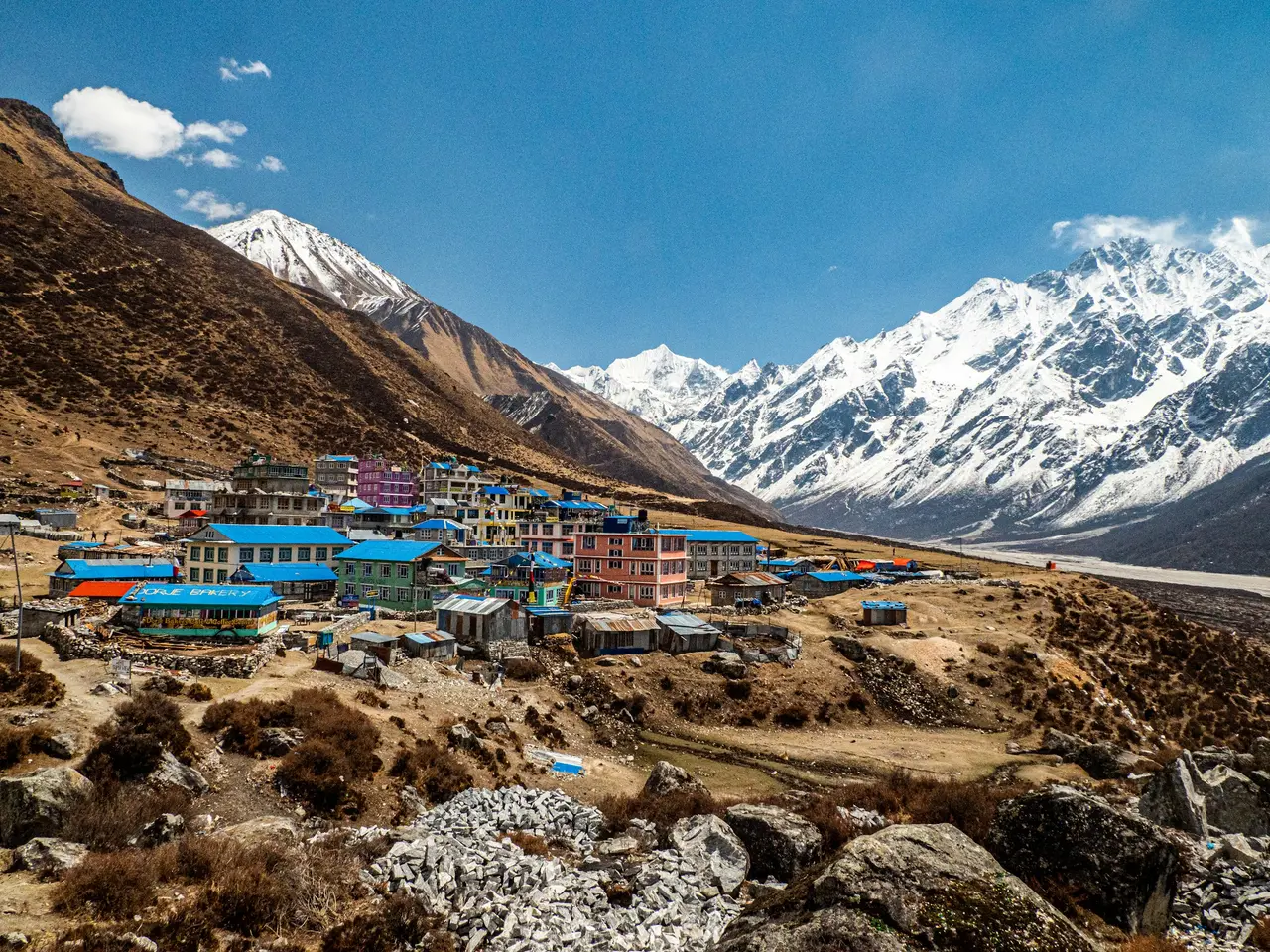
Thamel's gear market has three real tiers, and the honest answer to "is it genuine?" is that it depends entirely on which tier you are shopping in, not on the shop's sign. The first tier is authorised outlets and genuine Nepal-based brands: Sherpa Adventure Gear is a real Nepali company with its own factories and a fixed-price retail model, and a handful of shops carry properly licensed stock from international brands with import paperwork to match. The second tier is decent unbranded or locally-labelled gear made in small Kathmandu Valley factories: down jackets, fleece layers and trekking trousers that use real materials without claiming to be a brand they are not, sold at a fraction of Western retail because the labour and overhead are lower. The third tier is counterfeit: a jacket stitched with a North Face, Marmot or Patagonia tag that the actual company never touched, filled with low-grade down or synthetic fibre well below the loft the label claims.
Telling the tiers apart takes specific checks, not a feeling. A garment with no fill-weight or fill-power label sewn into the seam is either unbranded local stock (fine, if the price reflects that) or a counterfeit hiding the gap between claim and reality. Squeeze the jacket: real high-loft down springs back within a second or two; a fake mix of down and feather stays flatter and feels lumpier under light pressure. Check the zipper pull for a YKK stamp, which is not proof of an authentic brand but is a reasonable proxy for basic build quality, since counterfeiters routinely cut corners there first. And treat price as a signal rather than a bargain: a "genuine" -25°C down jacket offered at a tenth of its home-market retail price is not a steal, it is a different, lesser product wearing someone else's logo.
What is genuinely worth buying in Thamel, regardless of tier, is the commodity gear where brand authenticity barely matters: duffel bags, trekking poles, wool and synthetic hiking socks, buffs, liner gloves, gaiters and dry bags. These are typically priced from roughly USD 8–15 (NPR 1,050–2,000) for socks and gloves up to USD 20–35 (NPR 2,650–4,650) for a sturdy duffel, and the difference between a branded and unbranded version at that price point is cosmetic, not functional. What is not worth buying locally as new gear is anything where fit and performance under real stress matter most: mountaineering boots, which need a proper fit and a break-in period no shop visit can replace, and technical waterproof shells, where a counterfeit membrane will wet out on the first hard rain day above Namche. For those items, either bring gear you already trust from home, or use Thamel's genuinely useful rental economy: shops renting -20°C sleeping bags, down jackets and duffels by the day, at rates that are typically in the range of USD 1–2.50 per item per day, refundable deposit required. Treat every number in this section as a band to confirm on the day, not a quoted price; see the Nepal trekking packing list for what to bring versus buy.
| Item | Buy in Thamel? | Typical price band* |
|---|---|---|
| Duffel bag | Yes | USD 20–35 (NPR 2,650–4,650) |
| Wool trekking socks (pair) | Yes | USD 3–6 (NPR 400–800) |
| Trekking poles | Yes | USD 15–25 (NPR 2,000–3,300) |
| Down jacket, rented | Rent, don't buy | USD 1–2 per day |
| -20°C sleeping bag, rented | Rent, don't buy | USD 1.50–2.50 per day |
| Mountaineering boots | Bring from home | — |
| Technical waterproof shell | Bring from home | — |
*Indicative bands only; confirm current pricing in-shop.
Bargaining, concretely
Bargaining in Thamel works on souvenirs, textiles and unmarked gear, and barely works at all on anything with a fixed price tag or a brand-name receipt. The mechanic is simple: an opening asking price on unmarked stock is usually pitched at two to four times what the seller will actually accept, because the first number is a starting position, not an estimate. The realistic outcome, if you engage properly, is a discount of 20–40% off that opening figure, sometimes more on textiles and trinkets where margins are highest.
The actual script matters more than confidence. Ask the price, let the seller answer first, then counter at roughly a third to half of what they said, stated flatly rather than apologetically: "I'll pay [X]." Expect a counter-counter, and expect it to land somewhere in the middle after two or three rounds. If the gap will not close, thank them and start walking towards the door; a genuine final offer usually gets called out before you reach it, and if it does not, the first price was already close to fair. The single most useful habit is comparing the same item at two or three shops before committing to anything above about USD 10, since Thamel's shop density means genuine price competition is one door away. Bargaining hard on a bag of rice or a plate of dal bhat is not the local norm and reads as mean-spirited; save the negotiation for goods, not food, and not for the small fixed-price grocery and convenience stores that have become common on the main lanes.
Where to eat
Thamel's food economy splits into four honest categories rather than one scene. Bakery cafés, a Kathmandu institution since the backpacker era, serve breakfast pastries, cinnamon rolls, apple pie and strong coffee, typically USD 3–6 (NPR 400–800) for a full breakfast; they are where most trekkers eat the morning they fly to Lukla. Budget Nepali eateries just off the main tourist lanes serve dal bhat, momo and thukpa at genuinely local prices, often USD 2–4 (NPR 265–530) a plate, and are the best value and often the best food in the district if you are willing to walk two streets back from the busiest corners. Mid-range restaurants aimed squarely at tourists cover pizza, Indian, Thai and continental menus at USD 6–12 (NPR 800–1,600) a main, serviceable rather than remarkable. And a small cluster of rooftop restaurants trade slower service for a view over the district's rooftops and prayer flags at dusk, priced closer to the mid-range tier plus a premium for the setting.
A few practical notes apply across all four tiers. Ice in drinks and raw salads carry the highest food-safety risk for a traveller whose gut has not adjusted yet, and are worth avoiding in your first 48 hours regardless of how polished the restaurant looks. Bottled or filtered water is sold everywhere, but a reusable bottle with a filter or purification tablets saves plastic and money across a full trip. And a genuinely useful trekker habit is eating dal bhat at least once before departure, not for novelty but because it is the meal you will be eating for the next one to three weeks in the hills, and it is worth knowing you like it.
Where to sleep, and the noise map
Thamel's noise varies enormously by lane, and picking the wrong block turns a rest night before an early flight into a bad one. The core around Thamel Chowk, J.P. Road and Paryatan Marg carries the district's live-music bars and sound systems, and stays loud past midnight most nights of the week; guesthouses directly on or just off these lanes are convenient for gear shopping but poor for sleep. The northern edge towards Paknajol and Chhetrapati, and the eastern edge towards Jyatha, sit far enough back that the same fifteen-minute walk to the gear shops comes with genuinely quiet nights, and this is the trade most repeat visitors learn to make after one bad first stay. Budget guesthouse walls in the older buildings are often thin regardless of location, so a room facing an internal courtyard rather than the street is worth asking for specifically at check-in. For a fuller area-by-area comparison including Lazimpat, Boudha and the airport strip, see where to stay in Kathmandu.
Money: ATMs, exchange, and the rate to expect
Thamel has one of the highest concentrations of ATMs in Nepal, and using them is the simplest way to get cash at close to the interbank rate. Nepali ATMs typically dispense in NPR with a per-transaction withdrawal cap in the range of NPR 25,000–35,000 and a fixed transaction fee, so budget for several withdrawals rather than one large one, and expect your home bank to add its own foreign transaction fee on top; check both before you travel, since caps and fees change with bank policy. Licensed money-exchange counters along the main lanes offer USD, EUR and GBP cash conversion at rates close to the official interbank rate with a small margin, and are a legitimate alternative to ATMs for travellers carrying foreign cash, provided you use a counter displaying its licence and rate board rather than an informal street changer. Count what you receive before leaving the counter, and keep a stock of smaller NPR notes, since shops and taxi drivers throughout the valley routinely struggle to break large denominations.
The touts, and the polite exit
Thamel's tout economy runs on commission, not menace, and understanding that changes how uncomfortable it feels. A stranger offering "good price, trek tomorrow," a taxi driver insisting your chosen guesthouse is "closed" before redirecting you to one that pays him a cut, or a street seller pressing a singing bowl or tiger balm into your hands are all working a referral fee, and the transaction only completes if you engage. The reliable response is a short, flat "no, thank you" delivered without breaking stride, repeated once if needed, and then genuinely disengaging: no eye contact, no explaining why, no stopping to negotiate a decline. Matching your pace rather than slowing down removes the opening most scripts rely on. If a driver claims your booked guesthouse is closed or full, call the guesthouse directly rather than taking the driver's word, since this specific script is common enough to be a known pattern in Thamel and Kathmandu's tourist areas generally. None of this makes Thamel unsafe in any serious sense; violent crime against tourists is rare, and the friction is almost entirely commercial rather than dangerous, which is also why hiring a guide through a transparent, licence-verified channel rather than an unsolicited street offer removes the entire category of problem at once.
FAQ
Is trekking gear in Thamel genuine? It is a mix, and the shop's appearance tells you nothing. Sherpa Adventure Gear and a handful of licensed retailers sell genuine stock at fixed prices; unbranded local gear is usually decent value; but a "North Face" down jacket at a tenth of its retail price is a counterfeit, not a bargain, and its fill will underperform in real cold.
Should I buy or rent gear in Thamel? Rent high-cost, hard-to-verify items like down jackets and -20°C sleeping bags, since Thamel's rental shops are cheap, plentiful and low-risk for a one-off trek. Buy commodity items outright, such as socks, gloves, duffels and poles, where the gap between genuine and unbranded barely affects performance.
Is Thamel safe at night? Yes, in the sense that violent crime against tourists is rare and the main risk is commercial rather than physical: touts, inflated prices, and commission-driven steering. Stick to well-lit main lanes late at night, keep valuables secure as in any dense tourist district, and treat persistent approaches as a sales pitch, not a threat.
How much should I bargain in Thamel? Expect to negotiate 20–40% off the opening asking price on unmarked souvenirs, textiles and gear, using two or three rounds of counter-offers and a willingness to walk away. Fixed-price shops, branded goods with receipts, and food are not part of this norm, and hard bargaining over a meal price is generally considered inappropriate.
Where the real risk in Thamel is (and who fixes it)
The gear counterfeits, the tout scripts and the inflated opening prices are all inconveniences you can navigate with the checks in this guide. The one Thamel cannot fix from a shop counter is who leads you into the mountains once you leave it, and that is where an agency booking made on a street corner or a hostel noticeboard is riskiest: you are trusting a middleman's word for a guide's licence, altitude experience and safety record, with no way to check any of it before you pay. NepGem removes that layer. You see the guide's licence number, their recorded altitude history and real trekker reviews before you commit to a date, book a curated group departure or join one already filling, or hire that same guide directly for private dates at no agency mark-up. The gear you can sort out in an afternoon in Thamel; the guide is worth the extra five minutes of checking before you leave it to chance.


