

Chitwan and Bardia: Nepal's Jungle
Nepal's two safari parks solve different trips: Chitwan for easy access and rhinos, Bardia for tigers and near-empty trails. Costs and honest odds inside.
NepGem team · Local guides and trip planners
· 15 min read

Nepal's two premier wildlife parks answer different questions. Chitwan, close to Kathmandu and Pokhara, gives you a near-certain rhino sighting and well-developed tourist infrastructure. Bardia, a full day's drive further west, gives you Nepal's best tiger odds and trails you may share with nobody else all day. Both sit in the Terai, the flat lowland belt described in full in Nepal's geography from Terai to Himalaya, and Chitwan carries the added distinction of being one of Nepal's four UNESCO World Heritage properties, inscribed for its wildlife rather than its architecture. This guide compares them honestly on access, wildlife odds, safari format and cost, including the one question nearly every visitor searches and few operators answer straight: whether you should ride an elephant.
Two parks, two different trips
Chitwan is Nepal's most visited national park and the easier of the two to reach: roughly 5–6 hours by road from Kathmandu, closer again from Pokhara, with a well-established gateway town, Sauraha, offering everything from budget lodges to higher-end resorts on the park's buffer zone. Bardia, in Nepal's far-western Terai, is a longer commitment: roughly 12 hours by road from Kathmandu, or a short domestic flight to Nepalgunj followed by a two-hour drive, and its tourist infrastructure is noticeably thinner, with a small fraction of Chitwan's annual visitor numbers spread across a comparably sized protected area.
That access gap is also the reason the two parks feel so different on the ground. Chitwan's proximity to Kathmandu means jeep convoys, multiple safari operators competing for the same grassland tracks, and a wildlife-viewing experience built around volume and reliability. Bardia's remoteness filters out all but the more committed visitors, which means quieter tracks, closer and calmer wildlife, and a materially better chance of a genuine tiger sighting for anyone willing to give it two or three days rather than a rushed single afternoon.
Neither park is a substitute for the other, which is the honest starting point for planning either trip. A traveller with one spare day between a Kathmandu Valley itinerary and a flight home should default to Chitwan: it delivers reliable wildlife, comfortable lodges and a short transfer that fits a tight schedule without strain. A traveller building a longer Nepal trip around wildlife specifically, or one who has already done a Chitwan-style safari elsewhere and wants something less crowded, should give Bardia the extra day of travel it demands. Some visitors do both on a single extended trip, treating Chitwan as the easier warm-up and Bardia as the more serious wildlife leg later in the itinerary, though the combined transfer time between the two adds a genuine extra day that is easy to underestimate when planning on a map rather than against an actual road timetable.
Chitwan
Chitwan National Park, gazetted in 1973 as Nepal's first national park and inscribed by UNESCO in 1984, protects roughly 932 sq km of sal forest, riverine grassland and floodplain along the Rapti, Reu and Narayani rivers, with a further 750 sq km of community-managed buffer zone added in 1996. It is the country's flagship success story for the greater one-horned rhinoceros: national rhino counts have recovered substantially since the low point of the 1990s poaching era, with the large majority of Nepal's population concentrated in Chitwan today — treat any specific national figure as needing a fresh check against the most recent government census before you quote it, since counts are conducted periodically rather than continuously.
Sauraha, on the park's northern edge, is the main gateway, and the standard visit runs two to three nights, giving time for a morning jeep safari, an afternoon canoe trip along the Rapti, and at least one dawn or dusk session at a watchtower. Beyond rhino, Chitwan protects Bengal tiger (present but genuinely elusive given the dense forest cover), gharial and mugger crocodile, sloth bear, four-horned antelope and more than 500 recorded bird species; the government-run gharial breeding centre at Kasara is a worthwhile add-on for understanding the species' conservation story specifically. Rhino and deer sightings are close to guaranteed on any half-day jeep or canoe outing; tiger sightings, while possible, should be treated as a bonus rather than an expectation.
Sauraha's lodging spans a genuine range, from simple guesthouses charging a fraction of what riverside resort properties ask, to higher-end lodges built directly on the park's buffer zone with private balconies looking out over the Rapti floodplain; the difference in price generally buys proximity, room quality and a better restaurant rather than materially better wildlife access, since every visitor uses the same park entry gates and the same pool of licensed naturalist guides regardless of where they sleep. A standard two- or three-night stay is enough to cover a jeep safari, a canoe trip and at least one tower session without feeling rushed; a single overnight compresses the schedule to one activity block per day and increases the chance of missing a sighting simply through lack of repeated attempts. Chitwan is also a reasonable base for a half-day cultural stop in a nearby Tharu village, the indigenous community of the central Terai, where traditional stick-dance performances and mud-and-thatch house architecture give a look at Terai culture distinct from anything in the hills or the Kathmandu Valley.
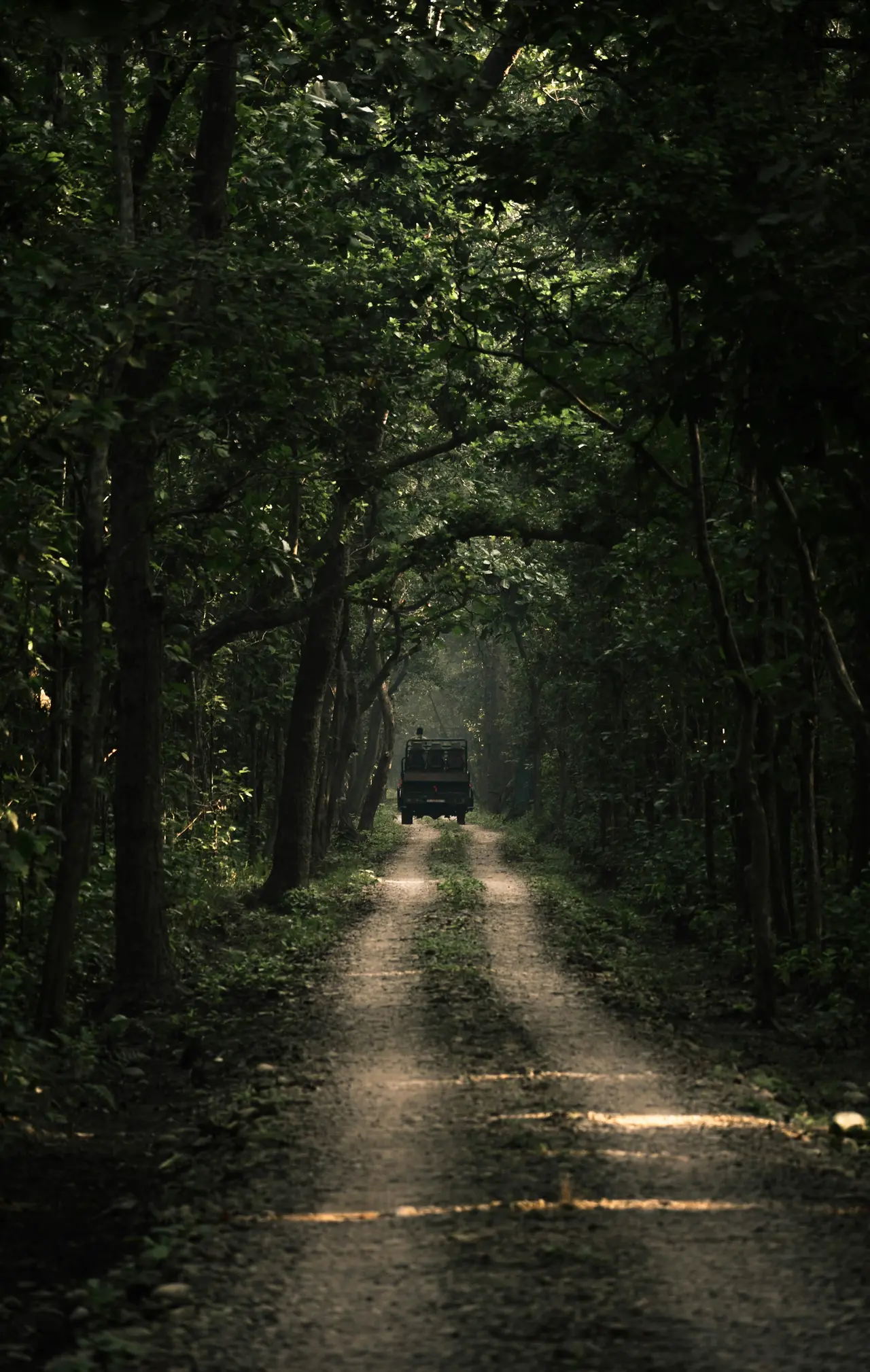
Bardia
Bardia National Park, established as the smaller Royal Karnali Wildlife Reserve in 1976 and extended and renamed Royal Bardia National Park in 1988 (the "Royal" prefix dropped after Nepal became a republic in 2008), covers roughly 968 sq km of forest and grassland along the Karnali and Geruwa rivers in Nepal's far west, contiguous with India's Katarniaghat Wildlife Sanctuary across the border, together forming one of the larger continuous tiger landscapes in the region.
Bardia is the honest answer to "where in Nepal can I see a tiger." Its lower visitor density relative to protected area gives resident tigers considerably less disturbance than Chitwan's busier tracks, and multi-day stays here consistently report better tiger sighting rates than short Chitwan visits, though a sighting is still never guaranteed on any single outing — this is wild, unbaited tracking, not a managed reserve with predictable viewing points. Beyond tiger, Bardia holds healthy populations of wild elephant, one of Nepal's larger swamp deer herds, gharial and mugger crocodile along the Geruwa channel, and Gangetic river dolphin sightings in the Karnali itself, which Chitwan cannot offer. Travellers combining the long overland journey west with an onward adventure leg sometimes pair Bardia with motorbiking in Nepal along the Mahendra Highway corridor, though the safari itself is best done slowly rather than rushed onto a tight overland schedule.
Getting to Bardia by road from Kathmandu is a genuine full-day commitment on the Mahendra Highway, and most travellers either break the journey overnight or take the Nepalgunj flight specifically to avoid an exhausting single-day drive. Once there, Bardia's lodges cluster around Thakurdwara village on the park's eastern boundary, generally smaller and more locally run than Sauraha's resort strip, and community-based tourism initiatives here channel a meaningful share of safari revenue directly into the buffer-zone villages that border the park, a model Bardia has leaned into more deliberately than Chitwan given its smaller, more concentrated visitor base. A three-night stay is close to the practical minimum given the travel investment required to get there; anything shorter risks spending more time in transit than in the park itself.
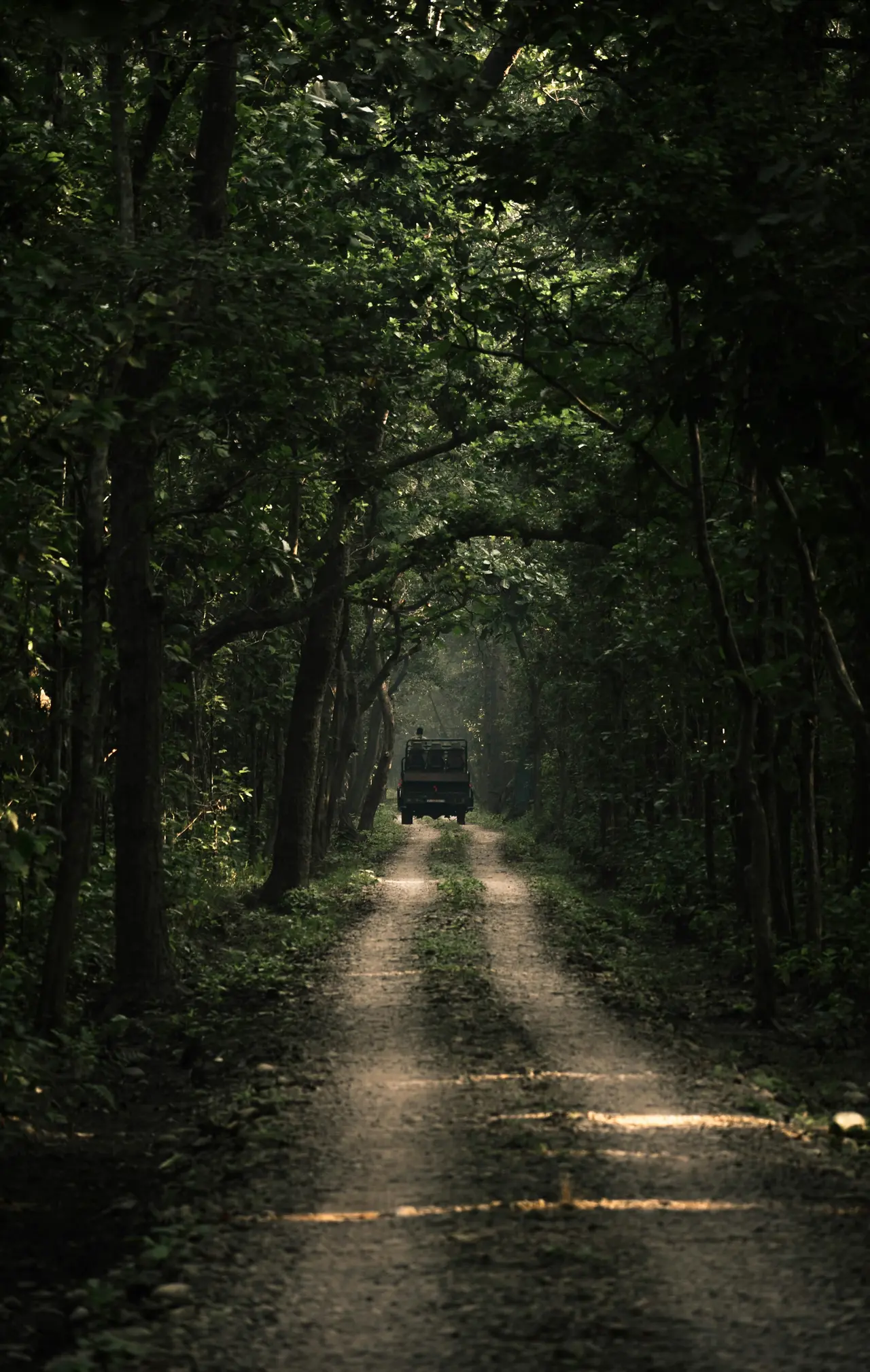
Safari types
Jeep safari covers the most ground in a single outing and gives the most reliable general wildlife odds in both parks, typically run as two-to-four-hour morning or afternoon sessions; Chitwan runs larger group vehicles given its visitor volume, while Bardia's operators are typically smaller and more flexible about route and pacing. Walking safari, always accompanied by an armed forest guard or licensed naturalist guide in Chitwan, is the most intimate format for tracking, birdlife and understanding forest signs at close range, but it carries genuinely higher risk around large mammals: rhino and sloth bear encounters on foot have occasionally resulted in serious injury in Chitwan's history, which is exactly why a trained guide's judgement on route and distance matters more here than on any other safari format.
Canoe safari, run along the Rapti in Chitwan and the Karnali or Geruwa channels in Bardia, moves quietly and low to the water, giving excellent close-range views of basking gharial and mugger crocodile and strong birdlife odds, though canoe trips are typically suspended during high monsoon-season water levels for safety. Tower or hide safari, watching from an elevated wooden platform over a waterhole or open grassland, is the lowest-effort and often highest-quality format precisely because the animals are undisturbed by vehicle or foot traffic; dawn and dusk sessions produce the best results, though as with every format here, patience is required and nothing is promised.
All four formats require a licensed naturalist guide, either park-employed or attached to your lodge, and it is worth asking directly about that licence before booking rather than assuming every guide carries one; an unlicensed local offering a cut-price walking safari outside the official system is both a legal grey area and a genuine safety risk given how close walking safaris bring you to potentially dangerous animals. Most lodges bundle two to three activities per day into a standard package rather than selling each format separately, and the honest advice for a first visit to either park is to try at least one jeep session and one slower format, canoe, walking or tower, rather than stacking every day with jeep safaris alone; the slower formats consistently produce the sightings and photographs visitors remember longest, even when the jeep covers more ground on paper.
The elephant question
Elephant-back safaris were historically Chitwan's signature activity, and the honest, direct answer to whether you should still book one is no. Captive elephants used for tourist riding are typically trained using restrictive methods, including the use of a bullhook (ankus) for control, and spend long working hours in harness carrying multiple riders, conditions that welfare organisations and increasingly Nepal's own conservation authorities have documented as incompatible with the animals' wellbeing. Nepal's National Trust for Nature Conservation and a growing number of Chitwan operators have moved away from elephant-back rides in recent years, shifting toward observation-only visits at elephant breeding and care centres, where visitors can watch elephants bathe, feed and socialise without riding them.
The practical case for skipping the elephant ride is not only ethical, it is also not a downgrade in wildlife experience: jeep, canoe, walking and tower safaris all deliver comparable or better sightings of rhino, deer, birdlife and, in Bardia, tiger, without the welfare cost that elephant riding carries. If seeing elephants specifically is part of what draws you to Chitwan, visit a breeding or care centre that does not offer rides and ask directly about its training and handling methods before you book, rather than assuming any elephant encounter is automatically the ethical version. This is a case where the more responsible choice and the better safari experience point the same direction.
The same question applies to Bardia, where a smaller number of operators historically offered elephant-back rides on request; the same welfare reasoning and the same recommendation apply there without exception. If an operator anywhere presents an elephant ride as an included, default part of a package itinerary, treat that as a fair question to raise before booking rather than after arrival — a straightforward request to substitute a jeep, canoe or walking session instead is one almost every reputable operator can accommodate without disrupting the rest of the trip.
Best months
February to April gives Nepal's safari parks their best combined visibility and comfort, and the reason is a specific park management practice rather than luck: both Chitwan and Bardia conduct controlled grass-cutting and burning in January and February, clearing the tall elephant grass that otherwise conceals wildlife for most of the year, while the dry season concentrates animals around the remaining water sources, making them easier to find. Daytime temperatures in this window are also comfortable rather than the punishing heat that arrives from May onward.
The monsoon, roughly June to early September, is the period to avoid: both parks restrict or suspend some safari activities during heavy flooding, tall grass has regrown to full height, leeches are abundant on walking safaris, and several lodges close or scale back entirely. October and November, immediately post-monsoon, offer clear skies and pleasant temperatures with grass still tall, a reasonable second-choice window. December and January are cool and dry but sit just before the grass-cutting season, so visibility across open grassland is somewhat reduced compared with the February–April peak.
Early morning temperatures in December and January can drop close to freezing in an open jeep, which surprises visitors who arrive expecting Terai lowland warmth year-round; pack a proper layer for dawn safaris even outside the winter months, since river mist and pre-dawn cold are a feature of both parks regardless of season. May, the last month before the monsoon breaks, brings genuinely high heat, often exceeding 35°C in the middle of the day, and while wildlife sightings can still be good as animals concentrate around shrinking water sources, the comfort trade-off is steep enough that most experienced visitors avoid booking this month unless their travel dates leave no other choice.
Cost
A Chitwan safari package built around two nights and three days typically covers a shared jeep and naturalist guide, one canoe trip, one or two tower sessions, park entry, and lodging with meals; a comparable Bardia package runs on the same structure but with the added cost of the longer transfer from Kathmandu. As of the 2026 season, the Chitwan National Park entry fee for foreign nationals is in the region of NPR 2,000 (about USD 15) per day — verify the current figure before you travel, since park fees are periodically revised, and Bardia's fee structure is broadly comparable.
Bardia's package cost structure runs the same way, though the added transport leg, whether the Nepalgunj flight or the full-day road transfer, adds a further per-person cost on top of the safari package itself, and is the main reason a Bardia trip typically costs more overall than an equivalent Chitwan trip despite similar in-park pricing. Budget-tier packages at either park cut corners on lodge quality and guide-to-group ratio rather than on the park entry fee itself, which is fixed by the government regardless of which operator sells you the trip; a noticeably cheap quote is worth double-checking for what it has trimmed, most often a shared larger jeep group or a more basic lodge, rather than assuming it reflects some undisclosed shortcut on the safari itself.
The jeep and naturalist guide fee is the one clearly shared cost on this trip, since a standard safari jeep seats up to six, meaning the fee splits further as more people join the same vehicle, while park entry, lodging and food are charged per person regardless of group size. Using an illustrative shared pool of USD 160 for the jeep and guide across a two-night package, and USD 140 per person for lodging, food and park entry:
| Group size | Shared pool ÷ group | Per-person fixed cost | Total per person |
|---|---|---|---|
| 1 (solo) | USD 160 | USD 140 | USD 300 |
| 2 | USD 80 | USD 140 | USD 220 |
| 4 | USD 40 | USD 140 | USD 180 |
| 6 | USD 27 | USD 140 | USD 167 |
FAQ
Can you see tigers in Nepal? Yes — Bardia has the best odds of any Nepal park, thanks to lower visitor density and a healthier tiger-to-visitor ratio, though sightings are never guaranteed on wild, unbaited tracking. Chitwan holds tigers too, but a rhino sighting there is far more likely on any given outing.
Chitwan or Bardia? Choose Chitwan for easy access from Kathmandu or Pokhara, near-guaranteed rhino sightings and established tourist infrastructure. Choose Bardia if you have an extra travel day, want a genuine shot at a tiger, and prefer quiet trails over Chitwan's busier jeep tracks and larger visitor numbers.
Should you ride elephants in Chitwan? No. Captive elephants used for tourist rides are typically trained with restrictive methods and worked long hours, and welfare concerns are well documented. Jeep, canoe, walking and tower safaris deliver comparable or better wildlife sightings without that cost, and are the better choice on every measure.
When is the best time for a Nepal safari? February to April, when park authorities have finished cutting and burning tall grass, opening up visibility, and the dry season concentrates animals near remaining water sources. October–November is a reasonable second choice; the June–September monsoon is the period to avoid.
What this safari costs once your group fills
Every number above assumes you are booking the jeep and naturalist guide alone, but a Chitwan or Bardia safari is naturally suited to sharing: the vehicle seats up to six regardless of how many book it, so the fixed guide-and-jeep fee splits further with every additional traveller. On a NepGem group departure, the per-person price shown recalculates live as bookings come in, moving from roughly USD 300 solo to around USD 167 once a jeep fills to six, exactly as the worked table above shows. If you would rather not wait for a group to fill, hiring your own licensed guide directly for a private safari on your own dates gets you the same transparent, fair-cost pricing without sharing a vehicle with strangers. Compare the live number on a NepGem departure page against a flat agency safari quote before you book — the gap is usually the group-size saving, not hidden margin.


