

Gosaikunda Lake Trek: Route, Pass and Best Season for 2026
Five days from Dhunche to a lake Hindus believe Shiva struck from stone, over a 4,610 m pass with an exit into Helambu and Sherpa villages beyond.
NepGem team · Local guides and trip planners
· 12 min read

Co-authored with a NepGem licensed trekking guide (licence no. on file) · Last verified: September 2026
Gosaikunda is a glacial lake at 4,380 m in Langtang National Park, and it is also one of the holiest sites in the Hindu and Buddhist calendar — a five-day walk from Dhunche that ends at water pilgrims believe Shiva himself created. It sits on the same ridge system as the langtang valley trek, close enough that many trekkers combine the two, and it shares a trailhead region with the tamang heritage trail. Unlike Langtang's glacier views or Everest's altitude records, Gosaikunda's pull is different: it is a working pilgrimage site, an oracle lake, and — if you cross the Laurebina Pass on the far side — a genuine link road into the Helambu valley.
 [GEN]
The lake Shiva made
Gosaikunda's name comes from the Hindu myth of Samudra Manthan, in which the gods and demons churned the cosmic ocean and produced Halahala, a poison capable of destroying the universe. Shiva swallowed the poison to save creation, and the burning in his throat turned his neck blue — one of his names, Nilakantha, means "blue-throated." Legend places the antidote here: Shiva struck his trident into the Langtang ridge, and the lake that filled the crater gave him water to cool the poison's fire. A stone trident still stands at the water's edge, and a submerged rock formation that locals read as a Shiva lingam is visible below the surface in clear conditions, which pilgrims take as confirmation of the story.
That myth is why roughly 20,000 pilgrims — Hindu and Buddhist, Nepali and Indian — climb the same trail every August for Janai Purnima, far more people than trek the route for scenery alone. Buddhist tradition folds the lake into its own cosmology, associating it with Avalokiteshvara, and Tibetan pilgrims bathe here too. Outside the festival window, the lake is quiet: a handful of teahouses, prayer flags strung across the ridgeline, and views south to the Ganesh Himal that most Everest-bound trekkers never see. Gosaikunda's status as a pilgrimage site rather than a scenery-first trek is also why its infrastructure is thinner than Langtang's — expect basic lodges, not bakery cafés.
Gosaikunda is also the largest of a cluster of 108 alpine lakes scattered across this stretch of the Langtang range, most of them too small or too remote to feature on any trekking map. The lake and its immediate surroundings were designated a Ramsar wetland site of international importance in 2007, recognition that sits oddly alongside its pilgrimage role but reflects the same underlying fact: this is a rare high-altitude wetland ecosystem, not just a scenic stop. Trekkers who make the short side trip to Saraswati Kunda or Bhairav Kunda on the acclimatisation day are walking through the edge of that same protected wetland system.
Day-by-day: 5 days from Dhunche
The standard Gosaikunda trek starts at Dhunche (1,960 m), a seven- to eight-hour drive or jeep ride from Kathmandu, and runs as an out-and-back loop through Sing Gompa. This is the itinerary NepGem quotes as the base "5 days from Dhunche," excluding the Kathmandu travel day at either end.
| Day | Route | Distance/time | Overnight altitude |
|---|---|---|---|
| 1 | Dhunche → Sing Gompa (Chandanbari) | 3–4 hrs, steady climb through rhododendron and oak forest | 3,330 m |
| 2 | Sing Gompa → Gosaikunda | 5–6 hrs via Laurebinayak (3,930 m), thinning tree line to open alpine ridge | 4,380 m |
| 3 | Acclimatisation day, side hike to Saraswati Kunda and Bhairav Kunda | 3–4 hrs round trip, both above 4,450 m | 4,380 m |
| 4 | Gosaikunda → Sing Gompa or on to Dhunche | 5–7 hrs descent, retracing Day 1–2 in reverse | 1,960–3,330 m |
| 5 | Dhunche → Kathmandu | 7–8 hr drive | — |
Day 2 is the trek's genuine test: over five hours of steady ascent above 3,900 m, much of it exposed ridge with no forest cover once you clear Laurebinayak. Altitude gain from Sing Gompa to Gosaikunda is roughly 1,050 m in a single day, which sits above the commonly cited 500 m/day guideline for sleeping altitude — the reason NepGem itineraries build in the Day 3 rest day at the lake rather than pushing straight over the pass. Trekkers who arrive at Gosaikunda with a mild headache and no other symptoms are typically fine to rest a night; anyone with worsening symptoms should descend rather than attempt the Laurebina Pass crossing the next day. Sing Gompa itself is worth the overnight beyond acclimatisation value — it hosts a small government cheese factory producing yak cheese, one of the few in the region still operating on the original 1950s Swiss dairy-development model.
Laurebina Pass, 4,610 m, and the Helambu exit
Laurebina Pass, at 4,610 m directly above Gosaikunda, is the trek's optional extension rather than a required feature of the base itinerary — cross it and you descend into Helambu instead of retracing your steps to Dhunche. The pass adds roughly three to four days to the standard Gosaikunda loop and turns a there-and-back trek into a genuine traverse.
From Gosaikunda, the crossing day runs over Laurebina Pass and down to Ghopte (3,430 m) or Phedi, a long seven- to eight-hour day with limited teahouse options and no reliable water source on the pass itself — carry enough for the full crossing. Beyond Ghopte the trail drops through Kutumsang (2,470 m) into the Helambu villages of Tarke Ghyang and Sermathang, ending at Sundarijal on Kathmandu's northern rim — the same finishing point used by the helambu trek. Doing the crossing links two of Nepal's most under-visited trekking regions into a single nine- to ten-day trip without repeating a single day's walking, and it avoids the Dhunche jeep road entirely on the way out. The trade-off is logistics: you need a guide or a very confident sense of route-finding on the pass itself, since the trail across the boulder field above Gosaikunda is marked with cairns rather than signage, and it is easy to lose in cloud or fresh snow.
Janai Purnima: trekking during the pilgrimage
Janai Purnima falls on the full moon of the Nepali month of Shrawan — usually early to mid-August — and it is, by a wide margin, the single most interesting time to be at Gosaikunda. Brahmin and Chhetri men renew the sacred thread (janai) worn across the chest, and thousands of pilgrims, many barefoot, climb from Dhunche in a single push to bathe in the lake and receive blessings from Hindu priests and Buddhist lamas who set up shrines lakeside for the festival.
Trekking during Janai Purnima is a different experience from trekking Gosaikunda in any other month. Teahouses along the route fill to capacity days in advance, prices rise, and the trail itself becomes a procession rather than a quiet ridge walk — expect to share the path with families, sadhus in saffron robes, and groups singing devotional songs on the ascent. It is monsoon season, so afternoon cloud and rain are near-certain and leeches are active in the lower forest sections below Sing Gompa; trekkers who come specifically for the festival accept the weather trade-off deliberately. Janai Purnima sits alongside Dashain and Indra Jatra as one of the year's major Hindu observances in Nepal, though unlike either of those Kathmandu Valley festivals, it draws its crowds up a mountain trail rather than into a city square. Anyone wanting the cultural experience without the crowding should aim to arrive at Gosaikunda the evening before the full moon and stay through the following morning, when the ritual bathing peaks, then descend against the incoming pilgrim traffic rather than with it.
Winter: when the lake freezes and the pass shuts
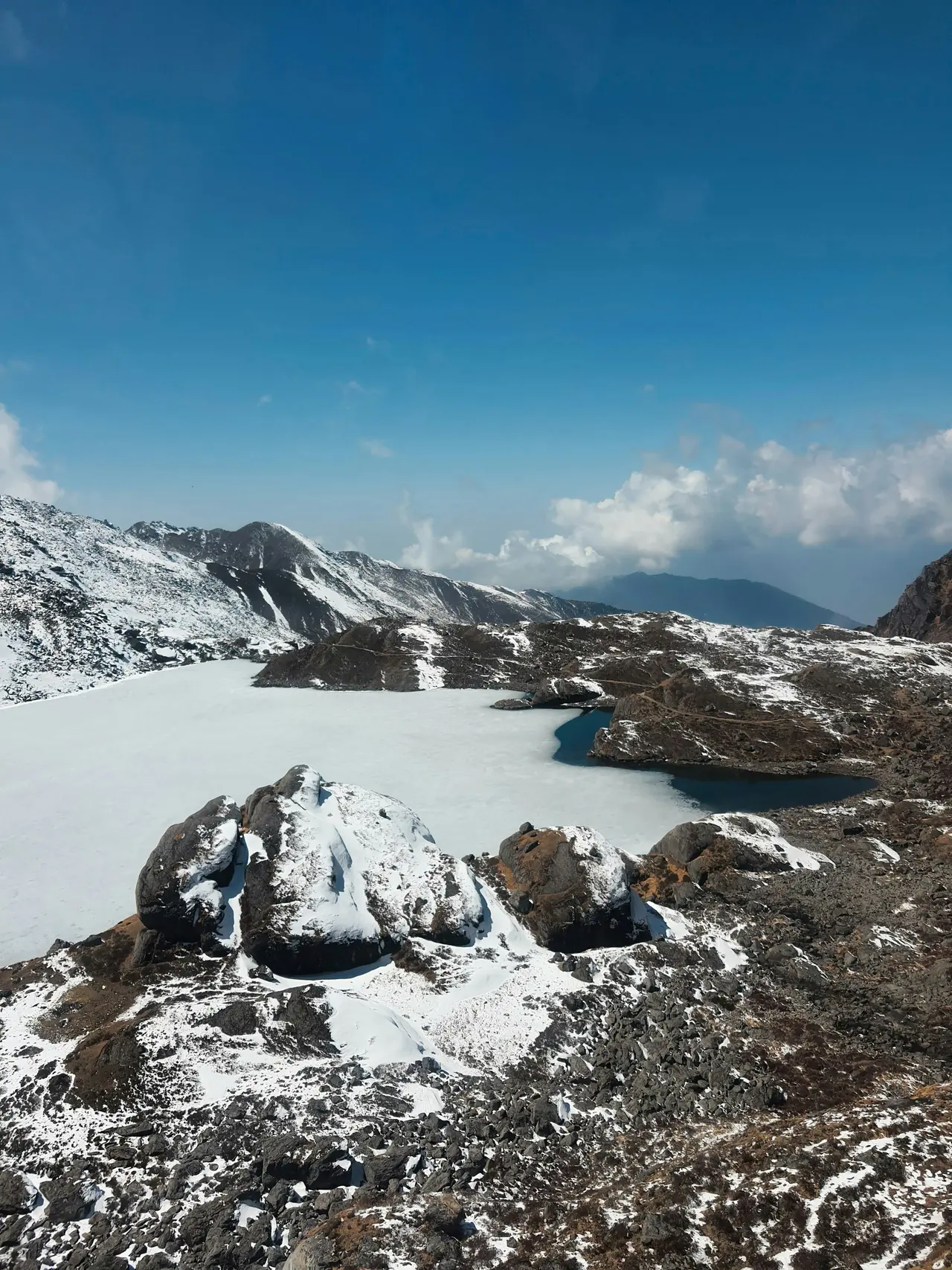
Gosaikunda freezes over from roughly mid-December through early March, and the lake's frozen surface is itself a minor spectacle — locals traditionally read the pattern of the ice each winter as an omen for the coming year. The trek to the lake itself remains achievable through winter for parties with cold-weather gear, since the trail to Sing Gompa and on to Gosaikunda is a maintained, teahouse-served route rather than a remote wilderness trail.
What changes is everything above the lake. Laurebina Pass typically carries enough snow from late December through February that the crossing to Helambu becomes unreliable and, in a heavy snow year, is not passable without crampons and route-finding experience most trekkers do not have — check current conditions with a guide or the Langtang National Park office before planning the crossing in winter. Several of the smaller teahouses at Sing Gompa and Gosaikunda close for the season entirely, so accommodation options thin from a handful to two or three, and it is worth confirming a lodge is open before committing to a winter departure. The upside is genuine: clear skies are more consistent in winter than during the pre-monsoon haze of April and May, the trail is close to empty, and the out-and-back trek to the lake without the pass crossing is one of the better low-crowd winter options within a day's drive of Kathmandu.
Cost and permits
A five-day Gosaikunda trek from Dhunche costs from roughly USD 470 travelling solo, dropping toward USD 220 per person once a group of six shares the fixed costs. As of the 2026 season, entry to Langtang National Park costs NPR 3,000 (approximately USD 23) for foreign nationals, plus a TIMS card at NPR 2,000 (approximately USD 15) — both are per-person fees that do not fall as a group grows. Since April 2023, the Nepal Tourism Board has required a licensed guide for trekkers inside national park and conservation area boundaries, which covers the entire Gosaikunda route.
Food and lodging costs rise gently as you climb, in line with every teahouse trek in Nepal — a dal bhat that costs roughly NPR 400–500 (USD 3–4) in Dhunche can run NPR 700–900 (USD 5–7) at Gosaikunda itself, since every sack of rice and bottle of gas is carried up on someone's back or a mule train from the roadhead at Dhunche. Porters are optional on a trek this short but worth budgeting for if you are combining Gosaikunda with the Laurebina Pass crossing into Helambu: expect roughly USD 20–25 a day, again a shared cost if you are travelling with others on the same departure. Because Gosaikunda's fixed costs are dominated by the jeep transfer rather than flights or restricted-area fees, it is one of the more forgiving treks in Nepal for a solo booker to join a group on — the per-person saving from sharing a jeep is proportionally larger here than on treks where flights dominate the budget.
| Cost item | Amount | Shared or per-person |
|---|---|---|
| Langtang National Park permit | NPR 3,000 (~USD 23) | Per person |
| TIMS card | NPR 2,000 (~USD 15) | Per person |
| Licensed guide, 5 days | ~USD 25/day | Shared across group |
| Kathmandu–Dhunche jeep, return | ~USD 180 total | Shared across group |
| Lodging, 4 nights | ~USD 8–10/night | Per person |
| Food, 5 days | ~USD 15–20/day | Per person |
What separates NepGem's pricing from a flat-rate agency quote is that the guide fee and jeep transfer form a shared pool that splits across however many people are on the departure, while permits, lodging and food stay individual. Book alone and you cover the whole shared pool yourself; join five other trekkers on the same departure and you each cover a sixth of it.
Gosaikunda Lake Trek: price by group sizeFAQ
How high is Gosaikunda? Gosaikunda sits at 4,380 m, with the Laurebina Pass immediately above it reaching 4,610 m. That makes the lake itself a moderate-altitude trek comparable to Annapurna Base Camp, while the pass crossing pushes into genuine high-altitude territory where acclimatisation planning matters and rushing the ascent from Sing Gompa is the most common cause of altitude symptoms.
When is Janai Purnima? Janai Purnima falls on the full moon of Shrawan, which usually lands in early to mid-August depending on the lunar calendar. Roughly 20,000 pilgrims climb to Gosaikunda for the festival, making it by far the busiest week of the trekking year on this route, with teahouses booked out and the trail itself functioning as a procession route.
Can you trek Gosaikunda in winter? Yes — the trek to the lake itself stays open through winter for parties with cold-weather gear, and clear skies are often more reliable than in the pre-monsoon haze. The lake freezes from mid-December to early March, and the Laurebina Pass crossing to Helambu becomes unreliable in heavy snow years, so plan the out-and-back route rather than the pass unless conditions are confirmed.
How many days from Kathmandu? The standard Gosaikunda trek runs five days once you count the Dhunche departure and return, or seven days total including the Kathmandu–Dhunche drive on both ends. Adding the Laurebina Pass crossing into Helambu extends the trip to nine or ten days, ending at Sundarijal on Kathmandu's rim instead of retracing the route to Dhunche.
Trek it with people already on the trail
Gosaikunda is a five-day commitment with one demanding acclimatisation day at 4,380 m, and most solo trekkers who look at booking it alone end up either delaying the trip or overpaying an agency to cover a guide and jeep transfer by themselves. NepGem's departures let you arrive solo and join a departure that already has people on it — the guide fee and Dhunche jeep transfer split across everyone already booked, so a departure with three other trekkers already committed cuts your share of the shared costs immediately, without you having to recruit anyone or wait for a fixed group-tour date. You see exactly how many trekkers are confirmed and the licensed guide assigned to the departure before you pay, and if you'd rather trek the Helambu extension with the same group, that option is flagged on the departure page too.


