

Mardi Himal Trek: The Best 5-Day Trek in Nepal
A ridge walk straight at Machhapuchhre's south face, 4,500 m and five days from Pokhara — route, High Camp reality, water limits and real costs.
NepGem team · Local guides and trip planners
· 12 min read

Co-authored with a NepGem licensed trekking guide (licence no. on file) · Last verified: September 2026
The Mardi Himal trek covers five days from Pokhara to a ridge-top viewpoint at 4,500 metres, walking straight at Machhapuchhre's south face from a distance of around six kilometres, without a single flight or high pass in the way. It is one of the newest routes in the Annapurna region open to independent trekkers, and it delivers a ridge-line closeness to a major peak that older, longer routes in the same massif do not match at any point on their itinerary. If you are choosing between the region's short treks, read the Annapurna Base Camp guide for the longer alternative first; Mardi trades ABC's full amphitheatre for a sharper, more focused single view in half the time. This guide covers the day-by-day route, the summit morning at the Upper Viewpoint, the ridge's real limits on water and lodging, and current permits and costs.
Why Mardi punches above its length
Mardi Himal earns a five-day trek's worth of mountain scenery because the ridge you walk puts you closer to Machhapuchhre than any other officially open trekking route in the Annapurna region. From the Upper Viewpoint at roughly 4,500 metres, the unclimbed, sacred fishtail peak's south face rises directly in front of you at a straight-line distance of about six kilometres, close enough that the mountain fills the frame without a zoom lens and close enough to watch cornices shift in the wind. Annapurna I, Annapurna South, Hiunchuli and Gangapurna are all visible from the same ridge, arranged in a wide panorama rather than the enclosed bowl you get at Annapurna Base Camp.
Part of what makes the route feel fresh rather than well-worn is how recently it opened. Mardi Himal was only made accessible to independent trekkers around 2012, decades after the Annapurna Circuit and Sanctuary routes were established, and the infrastructure still reflects that: smaller lodges, fewer of them, and a trail that has not yet been widened or re-routed by decades of heavy footfall. The result is a route that combines a genuinely dramatic mountain view with noticeably fewer trekkers on the trail than Poon Hill or ABC in the same season, which matters if crowding is part of what you are trying to avoid on a short Nepal trip.
Day-by-day: 5 days
| Day | Route | Altitude | Time |
|---|---|---|---|
| 1 | Pokhara → Kande (drive) → Deurali | 1,770 m → 2,100 m | 4–5 hrs |
| 2 | Deurali → Forest Camp → Low Camp | 2,100 m → 2,970 m | 5–6 hrs |
| 3 | Low Camp → High Camp | 2,970 m → 3,580 m | 4–5 hrs |
| 4 | High Camp → Upper Viewpoint → High Camp → Siding | 3,580 m → 4,500 m → 1,750 m | 7–8 hrs |
| 5 | Siding → Pokhara (drive) | 1,750 m → 850 m | 2–3 hrs |
Day 1 leaves Pokhara by jeep to Kande, a roadhead about 45 minutes away, then climbs through mixed forest past Australian Camp and Pothana to Deurali, a small saddle settlement with basic lodges. Day 2 continues through progressively denser rhododendron and moss-draped oak forest, where sunlight barely reaches the trail floor in places, to Forest Camp and on to Low Camp at 2,970 metres, the first point where Machhapuchhre becomes visible through gaps in the canopy.
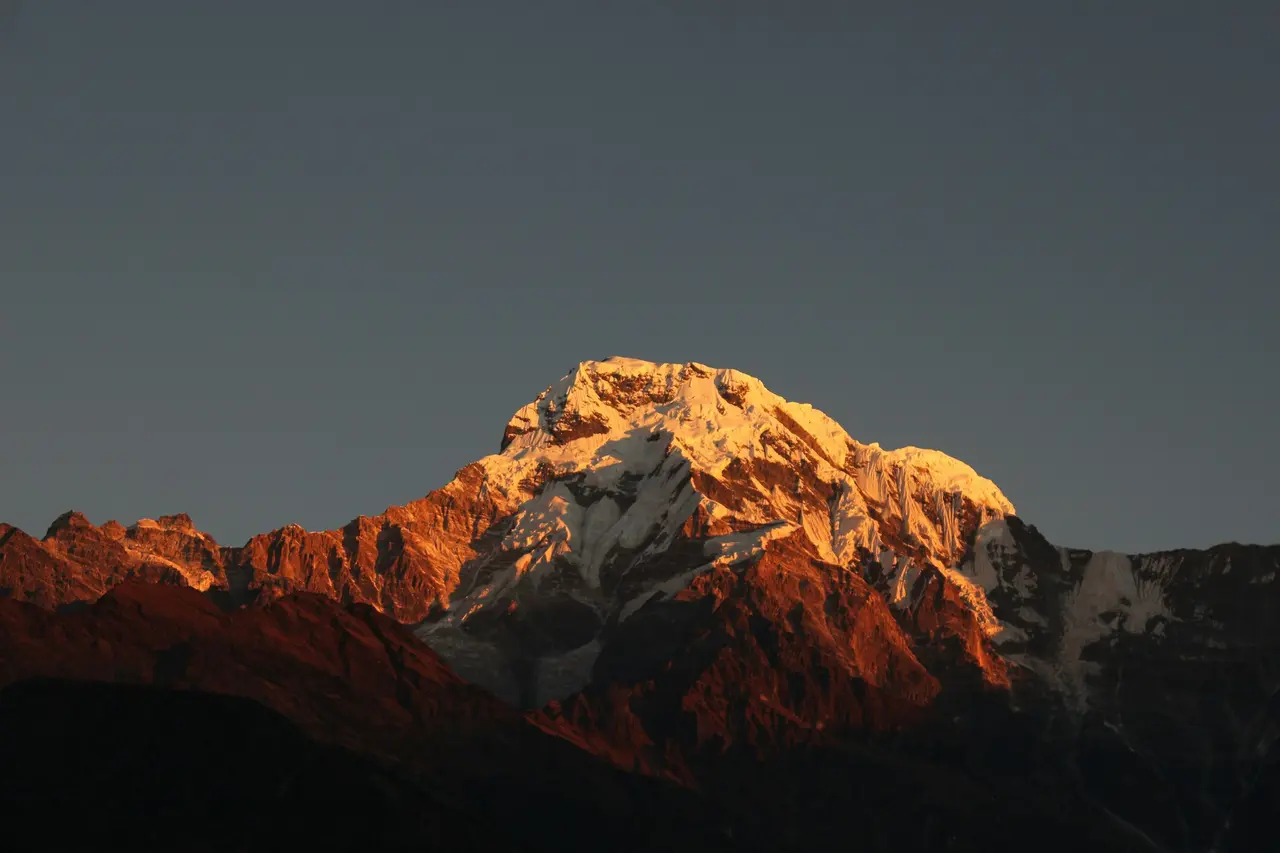
Day 3 is short in distance but decisive in character: above Low Camp the trees fall away almost entirely and the trail joins the open ridge proper, arriving at High Camp (3,580 m), a cluster of stone and tin lodges perched directly on the ridgeline with Machhapuchhre now filling the skyline ahead. The short distance on day 3 is deliberate rather than a sign of an easy day; it leaves the afternoon free for the body to adjust to the jump above 3,500 metres before the long summit push, and most guides use the extra hours for a short acclimatisation walk higher up the ridge and back rather than resting in the lodge all afternoon. Day 4 is the trek's main event, covered in full below, followed by a long descent the same day past Sidhing (also spelled Siding) village back toward the valley floor, since High Camp has too little lodging capacity to hold everyone overnight twice. Day 5 is a short final walk from Sidhing down to the roadhead at Lumre, followed by a drive of roughly two hours back to Pokhara, giving most trekkers time to reach the city well before evening.
High Camp to Upper Viewpoint: the summit morning
The Upper Viewpoint climb starts in the dark, typically leaving High Camp around 4:30–5:00 a.m. to reach the top before clouds build later in the morning, which happens on Mardi more reliably and earlier in the day than on most other Annapurna-region routes because of how exposed the ridge is to rising valley air. The climb itself gains roughly 900 metres over two to three hours on a narrow, sometimes loose trail with genuine exposure on both sides in the final stretch, more akin to ridge scrambling than the wide stone paths lower down the mountain. Pre-dawn temperatures at High Camp regularly drop below freezing even outside winter, and wind on the exposed ridge above it makes the effective temperature noticeably colder than the thermometer suggests, so a proper down jacket, gloves and a headlamp with spare batteries matter here in a way they do not on the forested lower stages.
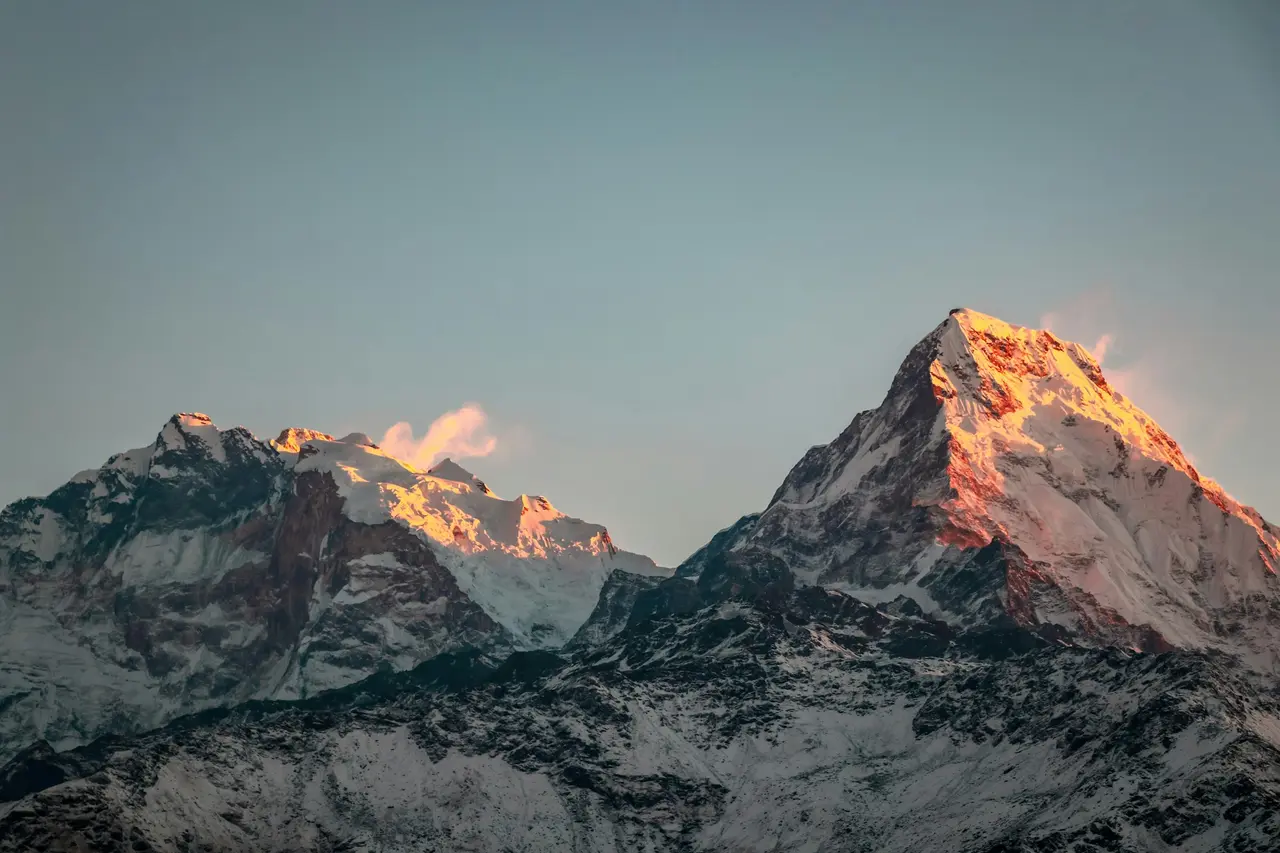
The reward is a 360-degree panorama that includes Machhapuchhre at close range directly ahead, Annapurna I and South to the west, and on clear mornings a long view back down toward Pokhara and Phewa Lake in the haze below. Weather on this exposed ridge changes quickly; many guides build in a buffer day at Low Camp or High Camp specifically so a cloudy first attempt does not end the trip without a summit view, since Mardi has less flexibility to simply wait out bad weather than a longer, lower-stakes itinerary would. After the viewpoint, the group descends to High Camp for a late breakfast, then continues down toward Sidhing the same day, making day 4 the longest and most demanding day of the whole trek by a wide margin.
Water, lodges, and the ridge's limits
The honest limitation on Mardi Himal is capacity, not difficulty. High Camp has only a handful of small lodges built directly on the exposed ridge, with limited rooms and even more limited dining space, and in the peak October–November window they fill completely most nights. Trekkers who arrive without a pre-arranged booking, or who are travelling independently rather than through an operator with an existing relationship with the lodge owners, have been turned away or forced to share a dining hall floor in the busiest weeks. Booking ahead through a guide or operator, rather than turning up and hoping, is not optional advice on this route the way it might be elsewhere in the Annapurna region.
Water is the other genuine constraint. Above Low Camp there is no reliable running water source directly on the ridge, so lodges at High Camp carry or store water for cooking and washing, and bottled or treated water for drinking typically costs more here than at equivalent altitudes elsewhere in the region, simply because it has to be carried further. Carrying a full 2–3 litre bottle from Low Camp, topped up before the climb rather than assumed available at High Camp, is standard guide advice on this route. Electricity at High Camp typically comes from a small solar setup rather than grid or generator power, so device charging is limited, often metered per hour, and unreliable on cloudy days; carrying a power bank charged in Pokhara is more dependable than counting on a lodge socket. None of this makes Mardi Himal a hard trek; it makes it a trek where the small, thin infrastructure is part of what you are trading for the closeness to Machhapuchhre and the lighter crowds.
Permits and cost
Mardi Himal sits inside the Annapurna Conservation Area, so it needs the same two permits as the Annapurna Circuit and Annapurna Base Camp: an ACAP permit and a TIMS card, both available in Pokhara. As of the 2026 season, ACAP costs NPR 3,000 (about USD 23) and the TIMS card costs NPR 2,000 (about USD 15) for independent trekkers — verify current rates before you travel, since both fees are set by the Nepal Tourism Board and the Annapurna Conservation Area Project.
For a five-day trek, guide fees, shared jeep transport and permit processing form a shared cost pool that splits across a group, while permits, lodging and food are paid per person regardless of group size:
| Cost component | Type | Approx. amount |
|---|---|---|
| Guide day rate (5 days) | Shared | USD 140 |
| Jeep, Pokhara–Kande–Pokhara | Shared | USD 40 |
| Permit processing (admin) | Shared | USD 20 |
| ACAP + TIMS permits | Per person | USD 38 |
| Lodging, 4 nights | Per person | USD 32 |
| Food, 5 days | Per person | USD 110 |
Solo, that totals roughly USD 380 all-in. On a group departure, the USD 200 shared pool splits across whoever else has booked the same date, so the per-person total falls as the group fills, while your own lodging and food cost exactly the same whether you are trekking with one companion or seven.
A porter is optional and not included in the table above; on Mardi's shorter distances a porter typically costs USD 18–22 a day, often shared between two trekkers carrying light daypacks between them. Budget an extra USD 25–35 per person across the trek for bottled or treated water above Low Camp, hot showers where available, and metered device charging at High Camp, all of which run higher here than on busier, better-supplied routes because everything above Low Camp has to be carried or solar-generated on site.
Mardi Himal: price by group sizeMardi vs. Poon Hill vs. ABC
Choose Mardi Himal for the closest single-peak view on the shortest reasonable trip; choose Poon Hill if four days and a sunrise panorama over a wider mountain range matter more than one peak up close; choose Annapurna Base Camp if you want to walk inside a full ring of peaks rather than face one from a ridge.
| Mardi Himal | Poon Hill | Annapurna Base Camp | |
|---|---|---|---|
| Duration | 5 days | 4 days | 7–10 days |
| Max altitude | 4,500 m | 3,210 m | 4,130 m |
| Signature view | Machhapuchhre close-up | Sunrise panorama, Dhaulagiri | Full ring of 7,000 m peaks |
| Crowd level | Low | High, especially the viewing tower | Moderate to high |
| Trailhead | Kande (drive from Pokhara) | Nayapul | Nayapul |
Trekkers with only four or five days who have already done Poon Hill, or who specifically want a quieter trail, gravitate to Mardi. It is also a strong pairing with a Pokhara city stay either side of the trek, since the trailhead and finish point are both close to the city rather than requiring a long separate journey the way Kathmandu-based treks do. Trekkers weighing all three routes against a shorter Kathmandu-based trip, rather than a Pokhara one, should also compare Mardi against the day hikes near Kathmandu before settling on a single itinerary, since a Pokhara-based ridge trek and a Kathmandu-based valley-rim walk suit different travel plans even when the number of free days is the same.
FAQ
How hard is Mardi Himal? Mardi Himal is easy to moderate: five days, a top altitude of 4,500 metres, and one genuinely steep, exposed day between High Camp and the Upper Viewpoint. Reasonable fitness and comfort with a narrow, sometimes loose ridge trail matter more than prior high-altitude experience.
Can you do Mardi Himal in 4 days? Yes, by combining the Kande-to-Low Camp stages into one longer first day and pushing straight through to High Camp, experienced trekkers can complete Mardi Himal in four days. This trades a rest and acclimatisation buffer for a shorter trip and suits fitter, time-pressed trekkers more than first-timers.
Do you need a guide for Mardi Himal? Since April 2023, Nepal has required a licensed guide for trekkers inside conservation areas, and Mardi Himal sits inside the Annapurna Conservation Area, so a guide is a legal requirement as well as a practical one given the ridge's narrow, sometimes loose trail above High Camp.
How much does Mardi Himal cost? A five-day Mardi Himal trek typically costs around USD 380 per person trekking solo, falling toward USD 220–250 per person once a group departure fills, covering guide, shared jeep transport, permits, lodging and food. Optional extras such as bottled water and hot showers add modestly to that total.
Arrive solo, trek with a group already headed up the ridge
Mardi's small High Camp lodges make solo booking riskier than on wider routes, since a handful of rooms fill fast in October and November. Joining a NepGem departure that already has people booked solves that problem twice over: your lodging is arranged as part of a confirmed group booking rather than a same-day gamble, and the guide's shared day rate splits across everyone on the trail with you, at whatever the current group size has already brought the per-person price down to. You get the same licensed guide, the same 4:30 a.m. start for the Upper Viewpoint, and company for the long descent day to Sidhing, without needing to organise the group yourself. Check the live departure page for the current group size and price before you book.


