

1953: How Everest Was Actually Climbed
यो कथा अहिलेलाई अङ्ग्रेजीमा मात्र उपलब्ध छ।
Eight failed expeditions, 400 porters, a Welsh physiologist nobody credits, and fifteen minutes on the summit that ended a thirty-year contest.
NepGem टोली · स्थानीय गाइड र यात्रा योजनाकार
· १६ मिनेट पढाइ

 [PHOTO]
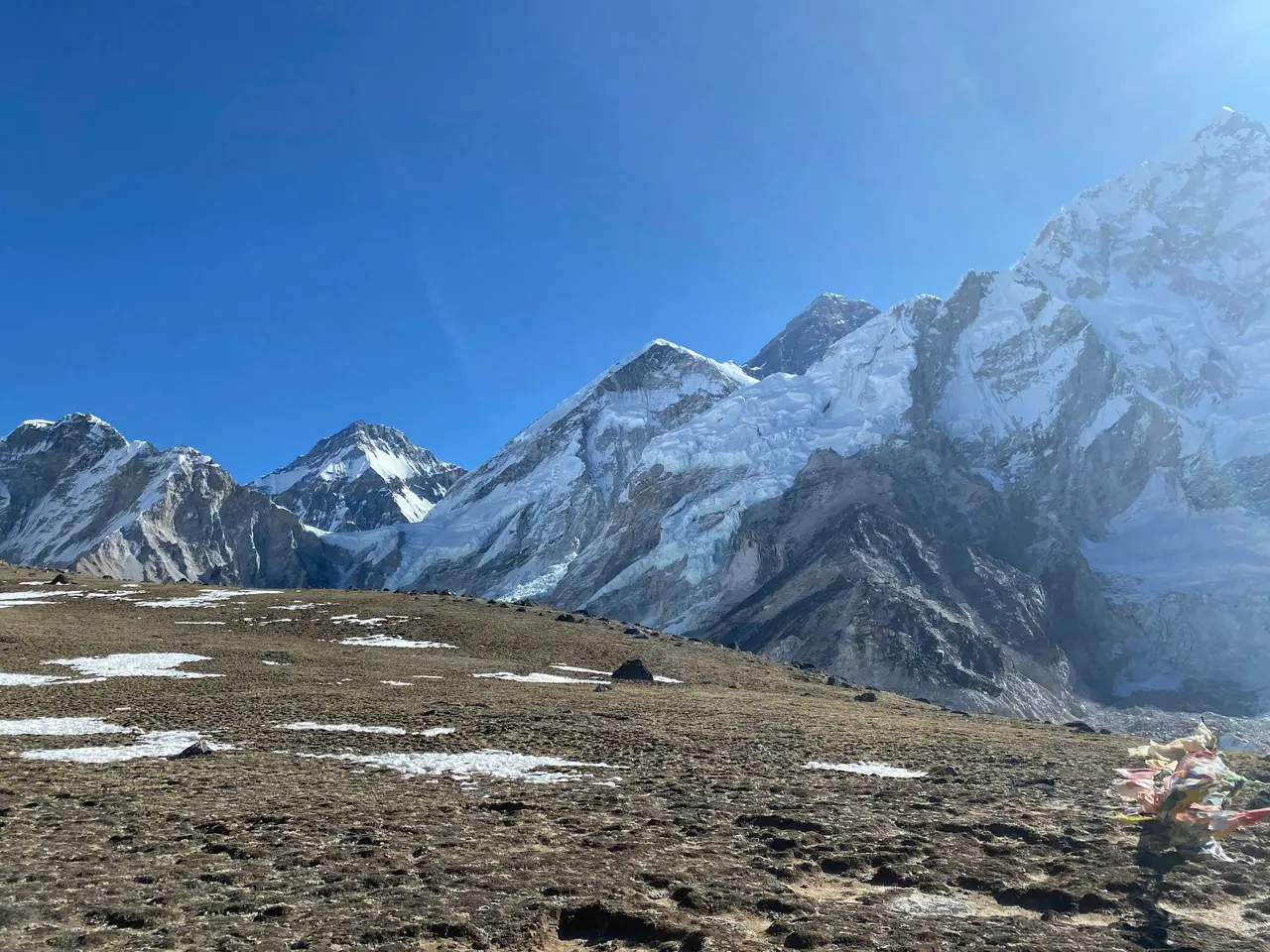
On 29 May 1953, at approximately 11:30 am local time, Edmund Hillary, a New Zealand beekeeper, and Tenzing Norgay, a Sherpa climber from the Khumbu and Darjeeling, became the first people confirmed to stand on the summit of Everest. They spent about fifteen minutes there before starting back down. Getting those two men to that point took a nine-person summit team, roughly 400 porters, close to 10,000 kg of food and equipment carried up from Kathmandu, and the accumulated failures of eight prior expeditions stretching back more than thirty years. It also took a physiologist most popular accounts leave out entirely. This is the version of the story with him back in it, along with the parts of the record that genuinely conflict — including, notoriously, who put a boot on the summit snow first.
Eight expeditions had already failed
By 1953, Everest had already defeated seven British expeditions and one Swiss expedition across three decades, each adding a piece of route knowledge and physiological understanding that the next attempt built on. The first, a 1921 British reconnaissance, mapped an approach from Tibet on the north side, since Nepal remained closed to foreigners at the time. George Mallory returned in 1922 on the first full attempt, during which an avalanche killed seven porters on the North Col, one of the earliest and starkest demonstrations of the mountain's indifference to skill or intent.
The 1924 expedition produced Everest's most enduring mystery. Mallory and his young climbing partner Andrew Irvine disappeared high on the north-east ridge on 8 June, last seen through a break in the clouds by fellow climber Noel Odell, moving toward the summit. Whether they reached it before dying on the descent remains genuinely unresolved; the fuller case for and against is examined separately. British expeditions in 1933, 1935 and 1936 followed, all from the Tibetan side, all turned back by weather, the technical difficulty of the Second Step, or both.
The closest anyone had come before 1953 was not British. In spring 1952, a Swiss expedition including Raymond Lambert and Tenzing Norgay — on his sixth Everest expedition, by then more experienced on the mountain than any Westerner alive — reached roughly 8,595 m on the south-east ridge, an estimated 250 m of vertical distance and several hundred metres of technical ground short of Everest's 8,848.86 m summit, before exhaustion and failing oxygen equipment turned them back. A second Swiss attempt that autumn fared worse, defeated by ferocious wind. By the time the British expedition assembled in early 1953, the mountain had a well-documented reputation for allowing parties to get close and then refusing them the last few hundred metres — a pattern that made Hunt's team acutely aware, from the outset, of exactly which parts of the route had already proven fatal to momentum on every previous attempt.
The logistics: 400 porters and 10,000 kg
The 1953 British Everest expedition, organised under the Joint Himalayan Committee of the Royal Geographical Society and the Alpine Club and led by John Hunt, moved on a scale closer to a small military campaign than a climbing trip. Approximately 400 porters carried close to 10,000 kg of food, oxygen cylinders, tents, rope and scientific equipment from Kathmandu to base camp, a march of roughly 17 days before the technical climbing even began. Sherpa climbers, a distinct and more experienced group from the general portering workforce, carried loads to the higher camps and, in several cases, climbed alongside the expedition's British members on technical ground.
Hunt structured the expedition as a staged pyramid of camps, each smaller and more exposed than the one below it, feeding a shrinking pool of climbers and supplies toward the mountain's upper reaches. Base camp sat at roughly 5,364 m at the foot of the Khumbu glacier; Camp IV on the South Col, at approximately 7,900 m, served as the final major staging point before the two summit pushes. This staged-camp approach, refined across the failed pre-war expeditions, meant that by the time a summit pair set out, dozens of other expedition members had already spent weeks establishing and stocking the route behind them — the 1953 success was built by a team roughly forty strong, even though only two names are remembered for the final steps.
Griffith Pugh and the oxygen nobody credits
The single greatest technical advantage the 1953 expedition held over the 1952 Swiss attempt that had come within 250 m of the summit was not courage or route knowledge. It was physiology, supplied by a Welsh-trained doctor named Griffith Pugh who is largely absent from the popular telling of the story he helped make possible.
Pugh had worked with the British expedition to Cho Oyu in 1952, treated by the team partly as a dry run for Everest, where he studied how climbers' bodies actually behaved at extreme altitude: how much fluid they needed to avoid the dehydration that impairs judgement and strength, how many calories sustained useful work above 7,000 m, what oxygen flow rate through a mask actually improved climbing performance rather than merely feeling like it should, and how existing high-altitude boots and clothing were failing to keep climbers' feet and bodies warm enough for the exertion involved. His research directly reshaped 1953's equipment and protocols: improved boot design, a diet calculated for the specific caloric and hydration demands of extreme altitude, and — most consequentially — an oxygen delivery system with flow rates tuned from measured performance data rather than the guesswork that had characterised earlier expeditions' oxygen sets, including the closed-circuit apparatus the Swiss team had struggled with in 1952.
The oxygen equipment itself came from British chemist Tom Bourdillon and his father, working with the Ministry of Supply's engineering resources, who developed both an open-circuit set for the summit attempt and a closed-circuit set later used on the first summit push. Pugh's contribution was making sure the physiology underneath the engineering was correct, and that the climbers actually knew how to use the sets to maximum effect. Harriet Tuckey, Pugh's daughter, later wrote a full biography of her father's uncredited role, arguing persuasively that his research was as decisive to 1953's success as any single climbing decision made on the mountain — a case the mountaineering establishment of the 1950s, more interested in a heroic narrative than a laboratory one, was in no hurry to make on his behalf at the time.
The Khumbu Icefall and the Lhotse Face
Two specific obstacles stood between base camp and the South Col, and both remain among the most dangerous sections of the standard route today. The Khumbu Icefall, a chaotic, constantly shifting field of ice towers and crevasses where the glacier drops steeply from the Western Cwm toward base camp, had to be crossed and re-crossed dozens of times as supplies moved up the mountain, each crossing a fresh gamble against a serac collapse or a bridge giving way underfoot. The 1953 team fixed rope and ladders through sections of it, establishing a route that, updated annually, is essentially the same one Everest Base Camp trekkers and climbers still rely on today.
Above the Western Cwm — a relatively flat, sun-trapped glacial basin the 1953 team nicknamed the "Valley of Silence" for its still air and radiant heat — the Lhotse Face rises as a steep wall of blue ice and snow leading toward the South Col. Climbing it required fixed rope on gradients steep enough that a slip without protection meant a long, likely fatal slide, and ferrying oxygen cylinders and camp supplies up it repeatedly was some of the most physically exhausting work of the entire expedition, performed largely by Sherpa climbers whose contribution the expedition's own published accounts, to Hunt's credit, went further than most of the era in acknowledging.
This same South Col line — Icefall, Western Cwm, Lhotse Face, South Col — remains the standard route on Everest's Nepal side seven decades later, climbed by the overwhelming majority of the roughly several hundred people who summit in a typical season. The Icefall in particular has never stopped being dangerous in the way it was in 1953: it killed sixteen Nepali mountain workers in a single avalanche in April 2014, a disaster that permanently changed how commercial expeditions staff and schedule their Icefall crossings.
Bourdillon and Evans: the attempt that nearly did it
Four days before Hillary and Tenzing's successful summit push, a first pair — Tom Bourdillon and Charles Evans — very nearly finished the job. On 26 May 1953, using the untested closed-circuit oxygen system Bourdillon had helped design, the two climbers pushed from the South Col to become the first humans confirmed to stand on the South Summit, at roughly 8,750 m, a point higher than any previous expedition had reached and only around 100 vertical metres and a technically uncertain ridge traverse short of the true summit.
They turned back. Evans's closed-circuit set had begun malfunctioning, the hour was late enough that a summit push risked a descent in darkness, and the unclimbed ground ahead — including the rock step later named for Hillary — was an unknown quantity for two exhausted men on a failing oxygen supply. It was, by any fair account, the correct decision and an extraordinarily narrow miss; Bourdillon and Evans's exhausted, precise report on conditions past the South Col, including their honest account of exactly where the closed-circuit set had failed them, directly shaped how Hunt briefed the second pair four days later, this time equipped with the more reliable open-circuit sets.
29 May, 11:30 am
Hillary and Tenzing left their high camp — Camp IX, pitched at roughly 8,500 m, higher than any tent had been placed on the mountain before — before dawn on 29 May, carrying open-circuit oxygen sets and food that had frozen solid overnight. They climbed the ridge above the South Summit that Bourdillon and Evans had been forced to leave unexplored, reaching a roughly 12 m near-vertical rock step wedged between a rock face and an overhanging cornice of ice — the feature now named the Hillary Step, one of the route's defining technical obstacles for every climber who has followed since. Hillary climbed it first, wedging himself into a gap between the ice and the rock, with Tenzing following on the rope behind him.
Above the step, the ridge eased toward a final, gently rising snow dome. At approximately 11:30 am, the two men stepped onto the summit together. Hillary photographed Tenzing holding an ice axe strung with the flags of the United Nations, the United Kingdom, Nepal and India; no photograph of Hillary on the summit exists, because Tenzing had never used a camera and Hillary did not ask him to try. Hillary buried a small cross given to him by Hunt in the snow; Tenzing, a Buddhist, left a small offering of food for the mountain, a practice consistent with Sherpa reverence for Chomolungma as a sacred place rather than simply a physical objective. They spent roughly fifteen minutes on the summit — barely enough time to take the photograph, look for any sign of Mallory and Irvine along the ridge below (they found none), and begin the descent before their oxygen supplies and the thinning afternoon weather forced them down.
News of the ascent reached London on 2 June 1953, the morning of Queen Elizabeth II's coronation, after James Morris, a correspondent for The Times travelling with the expedition, sent a coded runner-relayed message down to Kathmandu specifically to beat rival newspapers to the story. The timing, arriving as a coronation-morning headline, cemented the ascent in British public memory as much as the climb itself did.
"Who reached the top first?" — and why they refused to say
For the rest of their lives, both men were asked, relentlessly, which of them set foot on the summit first. Both consistently refused to answer the question as it was usually asked, insisting instead that they reached the top together, as a roped team, because that is functionally what happened: on a fixed rope with one climber leading and the other following a body length behind on a summit dome only a few metres across, "who was first" is a matter of a single pace, not an achievement one man made and the other merely witnessed.
Tenzing's own account, given in his 1955 autobiography written with James Ramsey Ullman, states plainly that Hillary stepped onto the summit slightly ahead of him — a detail Tenzing offered without apparent reluctance, framing it as an incidental fact of rope position rather than a hierarchy of accomplishment. Hillary, in his own later writing, described events consistently with this version. Yet the question took on a political weight neither man had asked for: in India and Nepal, where Tenzing was seen by many as a symbol of Asian and Sherpa achievement finally recognised on a stage the colonial-era mountaineering establishment had long dominated, there was considerable public pressure for Tenzing to claim precedence, or at minimum for the expedition's British organisers to have arranged for him to lead the final step. Hunt and the expedition's own accounts maintained the roped-team framing throughout, and Tenzing himself, across decades of subsequent interviews, never contradicted his own written account despite the pressure to do so. The disagreement that persists in popular retellings today is less a dispute between the two climbers than a dispute among the audiences who wanted the story to carry a different meaning than the men who lived it were willing to give it.
What happened to them afterwards
Edmund Hillary was knighted within weeks of the news reaching Britain and became, for the rest of his life, one of the most recognisable explorers in the English-speaking world. He led the New Zealand section of the Commonwealth Trans-Antarctic Expedition, reaching the South Pole overland by tractor in 1958, and later founded the Himalayan Trust, which built schools, hospitals and airstrips across the Khumbu region over decades of sustained, practical engagement with the Sherpa communities who had made his own climb possible — a commitment that arguably shaped Nepal's mountain regions as much as the summit day itself. He served as New Zealand's High Commissioner to India and Nepal in later life and died in 2008.
Tenzing Norgay became the first director of field training at the Himalayan Mountaineering Institute in Darjeeling, established specifically to train a new generation of Indian and Nepali climbers, and remained a towering figure in South Asian mountaineering until his death in 1986. Griffith Pugh continued a distinguished career in altitude and exercise physiology, later advising British Olympic athletes and contributing to cold-water survival research, but received little public recognition for his role in 1953 until his daughter Harriet Tuckey's 2013 biography reopened the case for his contribution decades after most participants, including Pugh himself, had died.
The mountain itself changed more slowly than the men who first climbed it. Everest would not see a second ascent for five years, and it took until the 1980s and 1990s for commercial guiding to turn a summit attempt from a national expedition into something an individually paying client could book. What it actually costs and requires to climb Everest today — permits, oxygen, guiding fees, weeks of acclimatisation rotations through the same Icefall and Lhotse Face the 1953 team fixed by hand — is a direct, traceable descendant of the staged-camp system Hunt's forty-strong team pioneered, even though a modern client's oxygen set and weather forecasting bear little resemblance to what Bourdillon, Evans, Hillary and Tenzing carried.
FAQ
Who climbed Everest first? Edmund Hillary and Tenzing Norgay reached the summit together, as a roped team, on 29 May 1953. Both men consistently declined to say which of them physically stepped onto the summit a pace ahead of the other, treating the achievement as shared rather than individually claimed.
Did anyone climb Everest before 1953? It remains unproven. George Mallory and Andrew Irvine disappeared high on the north-east ridge in 1924, last seen moving toward the summit, and Mallory's body was found in 1999, but no evidence confirms whether either man reached the top before dying on the descent.
How long were they on the summit? Hillary and Tenzing spent approximately fifteen minutes on the summit on 29 May 1953. In that time they photographed Tenzing with four national flags, searched briefly and unsuccessfully for signs of Mallory and Irvine, and left a cross and a food offering before oxygen limits forced their descent.
Who was Griffith Pugh? Griffith Pugh was the British expedition's physiologist, whose research into hydration, calorie needs, clothing and oxygen flow rates at extreme altitude directly shaped the equipment and protocols that made the 1953 summit possible. His contribution went largely uncredited for six decades until a 2013 biography by his daughter reassessed his role.
Walk the route the 1953 team spent weeks fixing
The Khumbu Icefall, the Western Cwm and the view up toward the South Col from Everest Base Camp are still there, still shaped by the same glacier the 1953 expedition spent weeks route-finding through, and still walkable by anyone who books a standard Everest Base Camp itinerary rather than a summit attempt. You do not need Bourdillon and Evans's oxygen sets or Pugh's calculated rations to stand where the expedition's forty-strong team staged its final push; you need a well-run 12 to 14-day trek. If you are travelling solo and would rather cross that ground with company than negotiate the logistics alone, join an Everest Base Camp departure that already has trekkers booked on the same dates, and walk into the Icefall's shadow with people who arrived, like you, to see the place a fifteen-minute summit stay in 1953 made famous.
Sources
- John Hunt, The Ascent of Everest (Hodder & Stoughton, 1953) — the expedition leader's official account, published within months of the climb.
- Tenzing Norgay with James Ramsey Ullman, Tiger of the Snows: The Autobiography of Tenzing of Everest (also published as Man of Everest, G.P. Putnam's Sons, 1955) — Tenzing's own account, including his description of the summit sequence.
- Walt Unsworth, Everest: The Mountaineering History (Allen Lane, 1981; revised editions) — an independent historian's account cross-referencing expedition records from 1921 through 1953 and beyond.
- Harriet Tuckey, Everest: The First Ascent: How a Champion of Science Helped to Conquer the Mountain (Rider, 2013) — a biography of Griffith Pugh drawing on his research notes and the Royal Geographical Society's archived expedition records.
- Royal Geographical Society and Alpine Club joint expedition archives, London — primary institutional records of the 1921–1953 British Everest expeditions.
Where these sources diverge — chiefly on the emphasis given to who stepped onto the summit first, and on how much credit Pugh's physiological research received at the time — this article has noted the disagreement rather than picking a side neither Hillary nor Tenzing themselves were willing to take.

